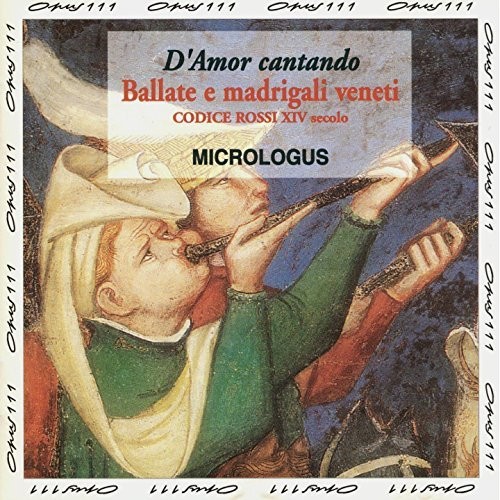
Era: Circa 1340... but that's the codex, the music itself was easily as much as a hundred years before
Form: Ars Nova (many)
Score: 82.8
Thoughts:
This was considerably more interesting than recent listens. The music and the performances were much more intriguing and powerful. The meslimatic singing (which I'm slightly growing tired of) actually had purpose and it's movements were purposeful and built the song instead of mindlessly "ran the scales". It's instrumentation was also a bit more diverse and interesting. The first song literally sounded like something out of the baroque, so also perhaps a bit more advanced for the time period (or maybe the performance just sounded as such due to the interpretation). I also liked the instrumental versions of the previously recorded vocal versions.
Info:
The Codex Rossi, compiled in Venice c.1340, is the earliest surviving source for Ars Nova music in Italy. The bulk of the manuscript consists of madrigals, always in two voices, and shows the emergence of the genre. The present program contains all of the ballatas in the manuscript, as well as track #2 (a sicilienne from the Reina manuscript from Venice). The compositions are all anonymous, with the exception of tracks #9 & #16 which may be by the Florentine composer Giovanni da Cascia.
RoundTheBendI miss the comfort in being sadProfile Ground Control
Era: 1370-1412
Form: Ars Nova (Ballata, Madrigali, Virelai, Canon, Motet)
Score: 81.5
Thoughts:
Much of it was pretty mediocre, but there were some good moments too. I mostly was focusing on the different forms described below and learning that, so maybe slightly distracted from the quality, but really some of it felt a bet too mathematical for me, and uninspiring in notation and in performance.
Info from medieval.org:
This disc presents selections from every genre in which Ciconia composed. The variety of sonority is particularly impressive.
Wiki:
The ballata (plural: ballate) is an Italian poetic and musical form in use from the late 13th to the 15th century. It has the musical structure AbbaA, with the first and last stanzas having the same texts. It is thus most similar to the French musical 'forme fixe' virelai (and not the ballade as the name might otherwise suggest). The first and last "A" is called a ripresa, the "b" lines are piedi (feet), while the fourth line is called a "volta". Longer ballate may be found in the form AbbaAbbaA, etc. Unlike the virelai, the two "b" lines usually have exactly the same music and only in later ballate pick up the (formerly distinctly French) first and second (open and close) endings. The term comes from the verb ballare, to dance, and the form certainly began as dance music.
The Trecento Madrigal is an Italian musical form of the 14th century. It is quite distinct from the madrigal of the Renaissance and early Baroque, with which it shares only the name. The madrigal of the Trecento flourished ca. 1300–1370 with a short revival near 1400. It was a composition for two (or rarely three) voices, sometimes on a pastoral subject. In its earliest development it was simple construction: Francesco da Barberino in 1300 called it a "raw and chaotic singalong".
The text of the madrigal is divided into three sections: two strophes called terzetti set to the same music and a concluding section called the ritornello usually in a different meter.
The virelai as a song form of the 14th and early 15th century usually has three stanzas, and a refrain that is stated before the first stanza and again after each. Within each stanza, the structure is that of the bar form, with two sections that share the same rhymes and music ("stollen"), followed by a third ("abgesang"). The third section of each stanza shares its rhymes and music with the refrain.[1][2] Thus, it can be schematically represented as AbbaA, where "A" represents the repeated refrain, "a" represents the verse set to the same music as the refrain, and "b" represents the remaining verses set to different music.
Within this overall structure, the number of lines and the rhyme scheme is variable. The refrain and abgesang may be of three, four or five lines each, with rhyme schemes such as ABA, ABAB, AAAB, ABBA, AAAB, or AABBA.[2] The structure often involves an alternation of longer with shorter lines. Typically, all three stanzas share the same set of rhymes, which means that the entire poem may be built on just two rhymes, if the stollen sections also share their rhymes with the refrain.
A canon is a contrapuntal (counterpoint-based) compositional technique that employs a melody with one or more imitations of the melody played after a given duration (e.g., quarter rest, one measure, etc.). The initial melody is called the leader (or dux), while the imitative melody, which is played in a different voice, is called the follower (or comes). The follower must imitate the leader, either as an exact replication of its rhythms and intervals or some transformation thereof (see "Types of canon", below). Repeating canons in which all voices are musically identical are called rounds—"Row, Row, Row Your Boat" and "Frère Jacques" are popular examples.
In western music, a motet is a mainly vocal musical composition, of highly varied form and style, from the late medieval era to the present. The motet was one of the pre-eminent polyphonic forms of Renaissance music. According to Margaret Bent, "a piece of music in several parts with words" is as precise a definition of the motet as will serve from the 13th to the late 16th century and beyond.[1] The late 13th-century theorist Johannes de Grocheo believed that the motet was "not to be celebrated in the presence of common people, because they do not notice its subtlety, nor are they delighted in hearing it, but in the presence of the educated and of those who are seeking out subtleties in the arts".
RoundTheBendI miss the comfort in being sadProfile Ground Control
Era: 1400s
Form: Ars Nova (Mass)
Score: 80.5
Thoughts: I really like some of the wilting rhythms and melodies Power does... he uses great rests and dynamics to give proper attention... like a good metal band.
Info: By the beginning of the 15th century, English composers were not only writing music with simpler harmonizations based on thirds, but cyclic cantus firmus masses as well. This was the historical era in which English composition was most influential in Europe, and the most important composers in the style were John Dunstable (c.1390-1453) and Leonel Power (c.1380-1445).
As I listened to this, I think I'd be floored by it live and in a cathedral. It likely would literally blow my mind and lift my spirits (emotionally, not religiously). But somehow in the recording, while there are many elements I like about it, as a whole it just didn't pull my chain.
RoundTheBendI miss the comfort in being sadProfile Ground Control
Era: 1397-1474
Form: Cantus Firmus Masses
Score: 81.5
Thoughts: The composition is just right in the spectrum of complex voicing and a clear movement to traditional tonality that will be heard for centuries to come. Probably the best mass I've heard so far. The recording was spot on and really brought the work to life.
Info: (from medieval.org)
Dufay's four mature cantus firmus masses are the Missa Se la face ay pale, the Missa L'homme armé, the Missa Ecce ancilla Domini, and the Missa Ave Regina cælorum. Of these, the Missa Ecce ancilla Domini is the shortest and most melodically intricate. (To this list should now probably be added the Missa Resvellies vous and maybe the Missa Puisque je vis and others.)
This is a full service setting of Dufay's mass, but instead of using chant as in most other such performances, polyphonic settings of the Propers De anglelis Dei officium (composed during the same time period) are used. In fact, this particular Propers setting is tentatively attributed to Dufay. The Propers setting is in the same style as Dufay's hymns, basically simple harmonizations of the chant theme. In other words, they are simpler than the Ordinary setting, but more complicated than plainchant.
RoundTheBendI miss the comfort in being sadProfile Ground Control
Era: 1397-1474
Form: Chanson
Score: 80.9
Thoughts: While it was pleasant and vibrant at times, I lost interest by the end of the album. The first 7 or so tracks were indeed intriguing though. I suppose by the end it became a bit too predictable. I know the refrain would come, I knew the cadence as it repeated over and over, etc. all before it'd happen, and the verse was variations on a simple melody over and over.
RoundTheBendI miss the comfort in being sadProfile Ground Control
Era: 1397-1474
Form: Chanson
Score: 80
Thoughts: I'd love to listen to this with a crackling fire in the background. While pleasant, nothing really stood out to me as anything exceptional. I suppose this makes sense for pop songs of the 14th century.
Info:
Souffrances & Deuils
Rondeau: Pour ce que veoir je ne puis (2 voices, gittern, 2 vielles)
Bergerette: Helas mon dueil, a ce cop sui je mort (2 voices, gittern, 2 vielles)
Mille bonjours je vous présente (clavicytherium)
Helas, et quant vous veray? (voice, gittern, 2 vielles)
Ballade: Je languis en piteux martire (voice, 2 vielles)
Ballade: Mon chier amy, qu'avés vous empensé (2 voices, gittern, vielle)
Louanges du Prince
Conrad Paumann: Mit ganczem Willen (clavicytherium)
Ballade: C'est bien raison de devoir essaucier (voice, 2 vielles)
Ballade: Resvelliés vous et faites chiere lye (voice, gittern, 2 vielles, clavicytherium, chorus)
L'amoureux transi
Franc cuer gentil, sur toutes gracieuse (clavicytherium)
Rondeau: Franc cuer gentil, sur toutes gracieuse (2 voices, gittern, vielle)
Bergerette: S'il est plaisir que je vous puisse faire (3 voices)
Rondeau: Par le regard de vos beaux yeux (voice, gittern, vielle)
Joies & Fêtes
Se la face ay pale (clavicytherium)
Rondeau: Je veuil chanter de cuer joyeux (2 voices, gittern, 2 vielles)
Mille bonjours je vous presente (voice, gittern, 2 vielles, clavicytherium)
Rondeau: Entre vous gentils amoureux (2 voices, gittern, vielle)
Rondeau: Puisque vous estez campieur (2 voices, gittern, 2 vielles)
Rondeau: He compaignons resvelons nous (2 voices, gittern, 2 vielles, clavicytherium)
Era: 1425-1497
Form: Polyphonic Motets/Mass
Score: 80
Thoughts: such complex melodies - it's funny to hear music from this time... which should really be archaic or something, yet is some of the most complex music ever written melodically/polyphonically, etc. modern pop music can't touch this. Jazz comes close when you have free jazz and all the instruments are doing their own solo... but structured melody like this is kind of unrivaled (imo)... I mean in this style, it's repeated for another 100 years or more, but eventually we actually dumbed down a bit musically. And to be honest, while impressive, I'm not crazy about it either... it is beautiful and quite the work, but after it's initial wow factor it doesn't really elevate me either.
Info from Medieval.org:
Although there are only four securely authentic motets attributed to him, Johannes Ockeghem (c.1420-1497) makes a definite impact on this style. The three settings of standard Marian texts, Alma Redemptoris mater, Ave Maria, and Salve Regina show Ockeghem's amazing array of 4-point counterpoint in what would otherwise be fairly typical settings of the era (aside from the lack of a cantus firmus in Ave Maria, also the one non-antiphon of the group). The massive 5-voice Intemerata Dei Mater uses a composite text, rather than a liturgical one, apparently put together by Ockeghem himself. It has a particularly low scoring, and an even more forceful impact, quoting motives he also used in the 5-voice mass torso Fors seulement and the 4-voice Missa Mi-Mi. Finally, Ut heremita solus is a probable work, surviving without a text, and showing some idiomatic instrumental thinking.
Together with the extant motets of Ockeghem, this program features an interesting work from his contemporary Guillaume Faugues (fl.c.1460). Faugues' surviving output consists only of four or possibly five mass cycles, but he is nonetheless (together with Ockeghem, Dufay, and the anonymous English composers) one of the significant early proponents of the 4-voice cantus firmus mass. The present example is seemingly paradoxical, in that it constructs a mass cycle on a bass dance. In this case, it is not La Spagna but a related, otherwise unknown, melody. Faugues' style is distinguished by an unusual use of literal repetitions to unify cycles.
Form: Vagantenlieder
Era: Late 1300s
Score: 81
Why this recording: suggestion from medieval.org
Info:Carmina Burana is a large German student manuscript from which Orff drew his famous 20th century setting. The current disc is the original 13th century version.
Although the manuscript, discovered in a Benedictine monastery in the mid-19th century and subsequently named Carmina Burana, is very extensive, the majority of the texts do not include melodies. These are to be inferred by the structure of texts or other cues which allude to well-known medieval melodies from other sources. German medieval music of this sort is generally known as Vagantenlieder, the poetry of the Goliards.
The lag between the technical & artistic developments in this source and those of Western Europe is substantial. Although the Carmina Burana dates from c.1220, it is actually grouped technically with analogous songs and notations in the Cambridge Songbook of c.1000. This is of course part of its interest, as it reflects an earlier practice which did not survive in quantity.
This is a classic performance, often raucous in tone. There are many other recordings to choose from, often with rather different performance decisions.
Thoughts:
Everyone is familiar with Orff's version. Pretty cool there's an interpretation that attempts to represent a sample of the original from music of the time.
I'm starting to really like these baritone singing parts where they barely are audible/so low they barely can enunciate anything. Music is intriguing. I haven't fallen in love with anything, but I think I'm flagging this for another listen... more to follow.
Difficult to compare because Orff version is totaly different (apparently he did not even take the medieval music as a starting point, but rather the poems, or even perhaps just the idea of an old booklet)
This O Fortuna from another "medieval" version is interesting too. But again, unrecognizable.
And to finish with, a flash mob ? Don't know if you like that, but it always put smiles on people's faces. I once saw one in my supermarket: it was fantastic
Also yeah as stated before: Carmina Burana is a large German student manuscript from which Orff drew his famous 20th century setting. The current disc is the original 13th century version.
You cannot post new topics in this forum You cannot reply to topics in this forum You cannot edit your posts in this forum You cannot delete your posts in this forum You cannot vote in polls in this forum
 RoundTheBend