Era: Renaissance
Year: 1580-1600
Form:
Score: 82
Thoughts: I enjoyed this. I didn't know what a Virginal was. Now I do. I actually enjoy the sound better than a harpsichord. Plus they look cool... well when I google it they all are highly decorated and the such. The music was entirely enjoyable and somehow spoke to me more... maybe it was just a nice break from the madrigals.
Info from medieval.org:
Contents:
1. Byrd: Pavan Tregian & Galliard
2. Byrd: My Lady Nevell's Ground
3. Johnson: Alman
4. Philips: Passamezzo Pavana & Galiarda
5. Morley: Fantasia
6. Bull: Duchess of Brunswick's Toy
7. Bull: Duke of Brunswick's Alman
8. Bull: John Lumley's Pavan & Galliard
9. Bull: Fantasia
10. Randall: Galliard "Can she excuse my wrongs?"
11. Farnaby: A Toye
12. Gibbons: Fantasia
13. Tomkins: Pavan & Galliard of 3 parts
14. Gibbons: Fantasia
15. Farnaby: Fantasia
As always, Leonhardt's performances are definitive in some sense. Although it might seem that the Philips label for this recording would make it easy to obtain, I have not found that to be entirely the case. Nonetheless, it is an important recording, featuring a good representative selection of music in this style.
This music is rather singular. The depth of an entire genre developed and produced over only a few of decades is amazing. Unfortunately, it is equally shocking that the entire school died out completely by the middle of the 17th century.
It was Byrd who presided over this era, and so it was he who was the first great master of the "English Virginalist" school of keyboard composition. He managed to establish this genre out of almost nothing.
RoundTheBendI miss the comfort in being sadProfile Ground Control
Era: Renaissance
Year: 1588-1589
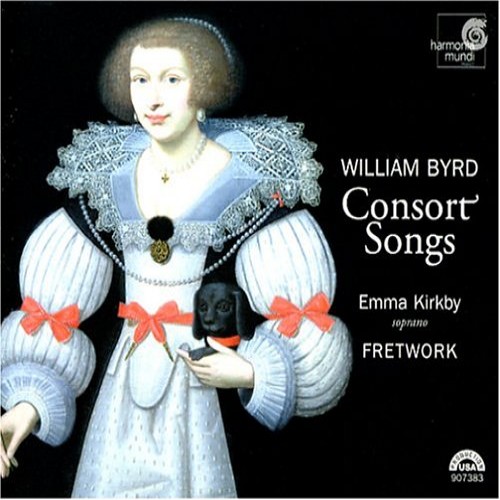
Form: Consort Songs
Score: 83
Thoughts: I think the immediate thing I noticed about this album is I actually paid attention to the lyrics. It helps it's in English, but even more so, the delivery made the lyrics stand out (I often ignore lyrics). Loved the variety of work on this record. Nothing special, but also solid.
From Wikipedia on Consort Songs:
A consort song was a characteristic English song form of the late 16th and early 17th centuries, for solo voice or voices accompanied by a group of instruments, most commonly viols. Although usually in five parts, some early examples of four-part songs exist. It is considered to be the chief representative of a native musical tradition which resisted the onslaught of the italianate madrigal and the English lute ayre, and survived those forms' brilliant but short-lived ascendancy (Brett 2001).
In contemporary usage, the term was confined to a number of songs for four voices accompanied by the standard mixed consort of six instruments, found in Teares or Lamentacions of a sorrowfull Soule by William Leighton, published in 1614, but was first used in the modern sense by Thurston Dart (Brett 2001).
William Byrd is recognized as the composer whose adoption and development of the consort song established its musical importance. He regarded it as a standard means to set vernacular poetry (Brett 2001).
Another cool instrument:
Info from Medieval.org:
Byrd was the greatest English composer of his day, presiding over the high point of musical development in that country. His musical output includes not only the requisite vocal forms, but also highly polished consort and keyboard works.
RoundTheBendI miss the comfort in being sadProfile Ground Control
Era: Renaissance
Year: 1592-1595
Form: Mass
Score: 75
Thoughts: I'm still amazed by these vocal performances and if I were in a cathedral I'd probably really get lost in it, but feel I've heard enough vocal only mass performance in ad nauseam. Wasn't terribly excited by this one, but as far as masses goes, it was quality.
*Ten more albums and I'll have completed the Early Music discovery/review and will move on to the Baroque.
RoundTheBendI miss the comfort in being sadProfile Ground Control
Thoughts: I guess I'm burned out on melismatic polyphony. It was neat to hear some accompaniment to the vocal motets. I'm not too familiar with the exact instruments to be sure, but brass and strings for sure. I don't mean to be rude, but there really is a reason why most music from the early music period is usually glossed over. Which is interesting because some of this early music isn't primitive at all, it's actually much more complex than 90% of what's listened to on this site (probably). idk - just rambling of course. Sometimes it feels like a pissing contest to be honest - it's like, who can impress the most. And I realize that the intent wasn't to stroke their ego, but to match the religious content they were writing music about - concepts and emotions that were at times meant to feel "beyond" human comprehension.
Info from wikipedia:
Orlande de Lassus (also Roland de Lassus, Orlando di Lasso, Orlandus Lassus, Orlande de Lattre or Roland de Lattre; 1532, possibly 1530 – 14 June 1594) was a Netherlandish or Franco-Flemish composer of the late Renaissance. He is today considered to be the chief representative of the mature polyphonic style of the Franco-Flemish school, and one of the three most famous and influential musicians in Europe at the end of the 16th century (the other two being Palestrina and Victoria)...
One of the most prolific, versatile, and universal composers of the late Renaissance, Lassus wrote over 2,000 works in all Latin, French, Italian and German vocal genres known in his time. These include 530 motets, 175 Italian madrigals and villanellas, 150 French chansons, and 90 German lieder. No strictly instrumental music by Lassus is known to survive, or ever to have existed: an interesting omission for a composer otherwise so wide-ranging and prolific, during an age when instrumental music was becoming an ever-more prominent means of expression, all over Europe. The German music publisher Adam Berg dedicated 5 volumes of his Patrocinium musicum (published from 1573–1580) to Lassus' music.
Info from the publisher Naxos:
"A selection of Lassus' motets, originally recorded in 1988 by Erik Van Nevel, leading the Belgium Concertino Palatino and Currende ensembles.
Orlando di Lassus was the most famous and influential 16th century European musician, and is today considered chief representative of the mature polyphonic style of the Netherlands school.
The Patrocinium Musices comprise five published volumes of sacred music, including several groups of his most highly regarded works, the motets.
Booklet includes sung texts."
RoundTheBendI miss the comfort in being sadProfile Ground Control
Era: Renaissance
Year: 1581
Form: Villanelles and Moresche (songs sung from the perspective of black Moorish servants/slaves)
Score: 82
Thoughts:This was quite the unique vocal performance. It reminded me of another similar album I heard earlier that I can't remember now that had a lot of onomatopoeia to it. It was a nice break from the onslaught of different versions of the mass.
Info from All Music (James Leonard):
What is music coming to? With a song called "I'm Called Mister Erection," lyrics including the deathless line "it's a piece of dog sh*t," melodies so primitive that they're infantile, and harmonies so primitive that they barely exist, it's hard to imagine ever calling this stuff music. But not only was this stuff written by Orlande de Lassus, one of the greatest of the late-Renaissance composers, he even saw fit to publish most of it. Apparently, despite his transcendent motets and his exquisite madrigals, Lassus had a sense of humor and all listeners can do is to take it or leave it. But if they decide to take it, they have to take it with a grain of salt and a sense of humor.
Rinaldo Alessandrini and the Concerto Italiano clearly decided to take it with a great sense of humor because this is one of the funniest discs of so-called serious music ever released. That this is the same rarified vocal ensemble that has released so many emotionally nuanced recordings of Monteverdi's madrigals is hard to believe, but clearly the singers are enjoying their work and their enjoyment is infectious. Although the singers still sing with wonderful expressivity and tremendous flexibility, the Concerto Italiano is not shy about making the sound of its voices match the crude, rude, and lewd music. The result is a terrific disc, but certainly not for listeners with delicate sensitivities.
RoundTheBendI miss the comfort in being sadProfile Ground Control
Thoughts: I liked the darker mood of this, but after a bit, I was like no, please stop the polyphonic singing. It's nearly hard to believe this was the musical tradition for like a thousand years. I mean there was other stuff and it changes entirely when your in the cathedral and it means something to you, I get that. And I really did like the first maybe 20 minutes of this, but then I was like please give me sandpaper toilet paper over this.
Info from wikipedia: https://en.wikipedia.org/wiki/Officium_Defunctorum
Officium Defunctorum is a musical setting of the Office of the Dead composed by the Spanish Renaissance composer Tomás Luis de Victoria in 1603. It includes settings of the movements of the Requiem Mass, accounting for about 26 minutes of the 42 minute composition, and the work is sometimes referred to as Victoria's Requiem.
Info from Medieval.org:
Victoria's Requiem (or Officium defunctorum) of 1605 is certainly one of his greatest compositions, and easily one of the masterpieces of the late Renaissance. It exemplifies the restrained yet fluent counterpoint for which Victoria is known.
Info from "guest" on gramophone:
This is a remarkable recording. In some ways it is like a rediscovery, for here is an approach not too far from Pro Cantione Antiqua at their best (one thinks of the pioneering recordings made in the 1960s and 1970s) and yet that group never recorded the work. That sense of rediscovery comes in fact as much from the difference between this and the versions by The Tallis Scholars and Westminster Cathedral Choir (under David Hill): though the latter places the Matins lesson Taedet animam meam in a semi-liturgical reconstruction of Lauds, this new recording takes a different approach and adds chant to the Requiem Mass itself, thus creating even more of a context for Victoria's magisterial work. We have therefore the Epistle and preceding prayer, the Tract, Sequence, Gospel, Preface, Lord's Prayer and Postcommunion in addition to the polyphony; this also means, for example, that the Kyrie is sung nine-fold with alternating chant instead of simply three-fold only in polyphony. Though no source is mentioned on the pre-issue copy I have, one may presume that the chant was taken from a suitable Spanish source by Luis Lozano Virumbrales, an expert in this field and author of the insert-notes (which describe in detail what the actual celebration of the Requiem Mass would have been like) together with Paul McCreesh.
The performance itself is stately and imposing, with a tremendous homogeneity of sound: the use of an all-male choir, together with the added chant, lends it a tangibly monastic feel, though it would have been a fortunate monastery indeed that had falsettists of this quality. About the performance of the chant there are two points of interest: firstly, that it is doubled, like the polyphony, by a bajon, common Spanish practice at this period, and secondly, that McCreesh is not afraid to have the falsettists singing the chant too. The pace of the polyphony often seems to be unhurried, but it never feels slow. Indeed, in almost every case the polyphonic sections are taken slightly quicker than The Tallis Scholars, and Westminster Cathedral Choir are of course faced with the hugely reverberant acoustics of their home building. From the beginning the singing is involving and incarnate, but the real magic comes nearer the end: from the Agnus Dei onwards one feels that the Gabreli Consort have really got the measure of the music and are allowing it to speak through them. The final great responsory, the ''Libera me'' is performed with heart stopping power and conviction.
The Tallis Scholars approach the music as though it were a concert suite, with no added chant, and in many respects this pays dividends, since they are able to build it up in an almost architectural way, whereas the Westminster choir, though they also add no chant except for the opening Matins lesson, somehow concentrate more on each separate section of the Mass. Of course this works: Victoria's sublime music is indeed conceived architecturally. And yet this is not all; McCreesh's approach shows something else, shows how it would have fitted into and complemented the liturgical framework without ever losing its own internal power and drama (for that of course is what it was intended for). A revelatory disc.'
RoundTheBendI miss the comfort in being sadProfile Ground Control
Been trying to wrap up the Romantic period... come 1888 with Satie it becomes difficult... even Mahler being more at the tail end of the Romantic period and nearly post-romantic... makes me actually want to delve into which work is considered Romantic still and which isn't... might do so when I actually listen to each piece. Probably to keep it easy on myself I'll just cut things off in 1890 and if it's post-romantic, it'll just go into the 20th Century list... then again I'm surprised I have 95 works from this period and I didn't really try.
Also Mahler is awesome. I'm very excited to get there, but another 300 years to go :).
Also I'm excited to nearly be done with music from "Antiquity until 1600" and start the Baroque when things really got interesting. There were for sure some interesting things from this period. I think there's just so much mediocrity (in the sense that often the vocal works I eventually tired of or that many of them all deal with similar subject matter - Mass). Those with interesting subject matter, I only at times took the time to read the subject matter. Sometimes fate, honor, courtly love etc. from the Minnesang is intriguing and sometimes it's like, let's put on the stupid hat cause that's the only way in hell I'm charging into a bloody field. Other things were a bit shocking or unexpected. Some truly beautiful. Long story short, I'm lucky to have the internet to help me understand a time of music that not only is often completely ignored, but literally was at times over a thousand years old. The old muses really have a hook in us, don't they? Once I'm done I'll probably recap the era with my favorite 10 albums or so.
RoundTheBendI miss the comfort in being sadProfile Ground Control
Thoughts: The forms and logic used here often is the foundation upon which composers in the Baroque would build... but it's vocal music - death by a cappella. Maybe if I were in one, it'd be much more enjoyable.
Info from Wikipedia:https://en.wikipedia.org/wiki/Tenebrae_Responsories_(Victoria)
The Tenebrae Responsories by Tomás Luis de Victoria are a set of eighteen motets for four voices a cappella. The late Renaissance Spanish composer set the Responsories for Holy Week known as Tenebrae responsories. They are liturgical texts prescribed for use in the Catholic observances during the Triduum of the Holy Week, in the Matins of Maundy Thursday, Good Friday and Holy Saturday. The compositions were published in Rome in 1585.
The eighteen Tenebrae Responsories are set for four voices each but with varying disposition of the voices soprano (S), alto (A), tenor (T) and bass (B). Soprano, tenor and bass are at times divided. Six responsories are dedicated to each Matins of Maundy Thursday ("coena Domini", the Lord's supper), Good Friday, and Holy Saturday ("Sabbato Sancto").
RoundTheBendI miss the comfort in being sadProfile Ground Control
Info from Medieval.org:
Frei Manuel Cardoso (1566-1650) entered a monastery in Lisbon in 1589 and remained there the rest of his life. This fact has been used partly to explain why his music continues to be clearly Renaissance in style well into the 17th century. However, other Portuguese composers of the period retained a similar style, especially those of the Alentejo School (Cardoso, Lobo, Magalhães).
Cardoso in particular seems to have incorporated some Baroque-style harmonic ideas into a contrapuntal style derived strictly from the Renaissance and Palestrina. His music is perhaps the most sumptuous of the group.
Info from Gramophone (Author: Guest):
I wonder what the seventeenth-century Portuguese composer Manuel Cardoso(1566-1650), for most of his life a monk at a Carmelite monastery in Lisbon, would have made of the idea that his music would enjoy a revival in the 1990s? This recording of his Missa Miserere mihi Domine (a first) from the Ensemble Vocal Europeen is a further – and very welcome – contribution to our knowledge and appreciation of the flowering of sacred polyphony in Portugal in the first half of the seventeenth century, music that, seen in a wider European context, seems “out of phase with its time” (to quote the accompanying notes). With music as fine as this, however, any latter-day perception of an unbroken line of musical progress seems completely irrelevant. The penitential nature of the chant on which this Mass is based is reinforced here by the choice of two wonderfully gloomy motets that are interpolated as if for performance at the Elevation and the Communion respectively, though that may not have been their original function. In particular, “Sitivit anima”, more usually associated with the Requiem Mass, is one of those marvellously expressive texts that so inspired Iberian composers, and Cardoso’s setting, highly reminiscent of Victoria with its never-ending sequence of suspensions, is up there with the best. Only the more straightforward, five-voice Magnificat lightens the tone of a disc that otherwise wallows in glorious misery.
Throughout, Herreweghe and his European choir sing superbly, responding sensitively to the words – notably in the longer movements of the Mass which are too often performed perfunctorily – and creating a full and sonorous sound that well suits Cardoso’s music. Full credit, too, to Herreweghe – and the Harmonia Mundi technicians – for achieving such an exceptionally satisfactory balance between the voice parts. A must for all Iberian enthusiasts, present and future.'
You cannot post new topics in this forum You cannot reply to topics in this forum You cannot edit your posts in this forum You cannot delete your posts in this forum You cannot vote in polls in this forum
 RoundTheBend