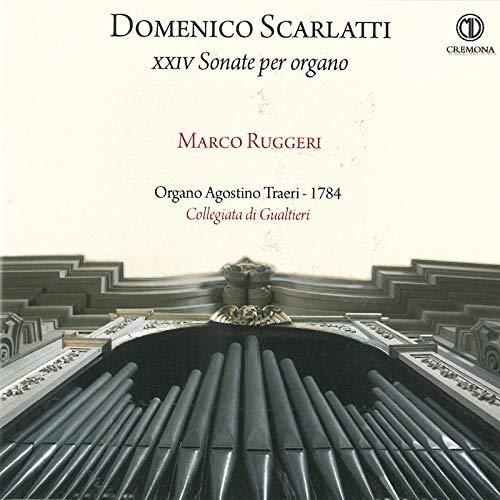
Alright, so I'm breaking methodology here for a bit cause this isn't on my listening list but Spotify recommended it to me and it's actually great. To me the above album has the ingenuity of Bach but the melodic powerhouse of Handel. I was quite impressed. Probably at least an 86.
Era: Baroque
Years: 1738
Form: Sonata
Score: 84
Thoughts: I have a similar impression from this album as I do with the one atop but the one atop is more interesting because of the delivery, but this too is fantastic. At times I did feel like these were warm up exercises or the such, but other times really liked the melodies and ingenuity.
Info from musicweb-international.com:
Quote:
Domenico Scarlatti, who was roughly a contemporary of Bach and Haendel, was born in Naples, and, around age 35, moved to Portugal, where he went to teach harpsichord to Princess Maria Barbara. When she married the future king of Spain in 1729, he went with her to Spain, where he lived the rest of his life. While he may have written some of his 555 harpsichord sonatas in Italy, it is likely that most of them were written in this later part of his life. The son of the famous composer Alessandro Scarlatti, his church music, written during the first part of his life, is largely unmemorable. But, something happened to Domenico when he left his native Italy - perhaps it was because he was no longer in the shadow of his father, but he went on to compose one of the greatest monuments of keyboard music in the world.
For those unfamiliar with Scarlatti's monumental oeuvre of harpsichord sonatas, the very first bars of this disc give an excellent idea of the type of music he composed. The quirky energy in the first sonata is very typical of his writing - his sonatas are all short and most are rapid, with expressive phrases that dance across the keyboard in an energetic display of virtuosity. Unfortunately, these works are often played on piano, where they lose the incisive sound that can only come from the harpsichord. Playing them on the piano means that the longer sounding notes merge into a confusing mass; few pianists can do justice to these works.
While some have compared this set of pieces, the only sonatas published during Scarlatti's lifetime, with Bach's Goldberg Variations, saying the latter may have been based on Scarlatti's works (partly because of the number of variations - 30), listening to them shows that this is not the case. Scarlatti's Essercizi are not variations; this set can be seen more as a collection of varied pieces, with no tonal nor thematic relationship.
The main thread that holds these works together is their energy. All but two of the pieces are marked allegro or presto; the two remaining pieces include one that is unmarked (sonata XI, a short work in C minor, that is slightly slower than most of the others, in which the melody is more central than the rhythm), and the final sonata, number XXX, which is a fugue, marked moderato. This is a brilliant fugue, based on a very simple, ascending subject, that reaches a fitting apotheosis to close out this set.
Yet Scarlatti was not a writer of fugues; of his 555 sonatas, only a small number are fugues. As John Gillespie says, in his book, Five Centuries of Keyboard Music, "If Scarlatti's music does not strive for profundity, it forever has its elegance. A relentless searcher for brilliant and unusual effects, Scarlatti avoids triviality and aims for an expressive, sometimes dramatic line." There are few ornaments in these works, and Scarlatti instead uses brilliantly fast runs along the keyboard to embellish his pieces. He was a master of applying rhythm to his sonatas, as can be heard in sonata XIII, with its simple melody containing many repeated notes, giving it a catchy rhythm, or what Joseph Payne calls, "infectiously cheerful chatter".
Payne performs these works very well. He is right at home with the rhythm and energy of these pieces, and, as in all his recordings for Bis, plays a beautifully-sounding instrument. This recording is highly recommended as an introduction to Scarlatti's works, yet, for those who wish to discover the full range of his works, Scott Ross's masterful recording of all 555 sonatas is the only choice.
Kirk McElhearn
RoundTheBendI miss the comfort in being sadProfile Ground Control
Era: Baroque
Years: 1736
Form: Marian Hymn
Score: 82.5
Thoughts: Easily the most creative Amen I've heard thus far. And that's kind of tongue and cheek, but mostly true. Overall I see how this is quality and a notable maturation of religious music. Glad I gave it a listen as a staple, but neither did it move me greatly. LSO and Abbado command a solid performance upon which the soloists flutter only a little.
Info from Archivmusic.com:
Quote:
I heard Abbado's version first and was immediately won over to a work I've had some reservations about. My memories are of performances which tried to purify the piece. Abbado does no such thing, but offers the full range of Neapolitan flavours. Margaret Marshall is magnificent, with a lovely high register which can produce a steely edge followed at once by an effortless bell-like quality. There is a splendid partnership with Terrani—blend is not quite the right word. The element of contrast makes for greater intelligibility.
In the Scimone LP version (Erato/Conifer), Terrani is partnered by Ileana Cotrubas. This produces a somewhat woolly mix which rather goes with the general feel of the performance, competent though it is. Marshall and Terrani really go to town on these doom-laden Italian trills, which Cotrubas and Terrani ride too gently. Besides, Scimone's steering of I Solisti Veneti through the slow music produces many ragged patches. Abbado's direction is commanding and his strings are well-drilled, which makes for better accompaniments. His organ continuo (Leslie Pearson) is quietly present with conciliatory comments, whilst Scimone's harpsichord cannot hide an irreverent chuckle now and then. Most of all, the Abbado record is warm and passionate—and the recording quality is superior, with the CD a good way ahead of an already top quality LP.
-- Gramophone [4/1985]
RoundTheBendI miss the comfort in being sadProfile Ground Control
Era: Baroque
Years: 1737
Form: Opera
Score: 82.5
Thoughts: I didn't like this performance nearly as much as I did with Jordi Savall, but it was the best I found of the Castor et Pollux Suite. It too did not perform the full opera, which again I actually really liked and enjoyed. The music itself is solid. It was also nice to hear the round from Henry Purcell at the beginning. I'm missing 50 highfalutin adjectives, but I think it was good but not great is ok for my purposes for now.
Info from Archivmusic.com:
Quote:
"Rameau completed his second Tragédie in 1737 but, as with all but one of his surviving tragic operas it witnessed changes to the original score in revival. Such changes, often far-reaching, were implemented for a variety of reasons. In the present instance, 1754, Rameau seems to have been chiefly concerned with accommodating the taste of the time. Thus not only did he dispense with the Prologue, still de rigueur in 1735, but also added several engaging dances whose idiom is often strikingly up to the minute, so to speak. The suite played here is drawn from the 1754 version of the opera... For the most part Brüggen chooses effective tempos and phrases the music gracefully; perhaps the concluding Chaconne is a shade hard-pressed, stripping it of some of its grandeur, but it and much else here is beautifully played. Even so, I found myself longing for a vocal air or two to break up a sequence of orchestral pieces which lasts for well over half an hour. While by no means denying the disc a warm welcome—better this by far than nothing at all—it is no substitute for the whole. A very presentable, complete recording of Castor et Pollux in its 1754 revision, directed by Charles Farncombe, is lying in the vaults of Erato (2/83—nla)--let's have it please! Meanwhile, acquire the new disc from Philips. It is beautifully recorded and is a delicious carrot." -- Gramophone [4/1991]
Era: Baroque
Years:
1735 - Les Indes galantes
1749 - Naïs
1749 - Zoroastre
1763 - Les Boréades
Form: Opera
Score: 85
Thoughts: This was quite interesting because it is a collection of music from the aforementioned operas but no singing. Overtures make sense, but aria's missing the vocals, etc. Which actually probably was best for me. It gave me the best bits of the music (the part I really want) and I didn't get lost in 3 hours of recitatives that were boring because I'm not watching/reading along to the opera for this project. I've become a fan of Jordi Savall and his performances/interpretations of early music and baroque thus far, and this continued to be top notch. For the music itself, I really like this collection because it encapsulated so many different music types and maturation across them. Artisan to Artistry, it did it all, and it did it well. I can see how theatric the music can be, but also how good the music is on it's own. At the same time it didn't reach great heights, but solid nonetheless.
AllMusic Review by Stephen Eddins:
Quote:
With this two-disc hybrid SACD set, Jordi Savall turns his considerable gifts as a performer and scholar to the music of the French court during the reign of Louis XV in the middle years of the 18th century. The confluence of Louis XIV's love of music and dance and the talent of Jean-Baptiste Lully had constituted the high point of royal French patronage of music; Louis XV was relatively indifferent to music and it wasn't until Rameau was in his sixties when he was finally granted a royal appointment. Throughout his long career, though, he enjoyed great popular success and was considered France's outstanding composer, and he produced a large body of work including over 20 operas. As the excellent program note to this recording diplomatically puts it, Rameau's work was "profoundly original to the point of sometimes bordering on the strange," and that strangeness contributes substantially to its appeal to modern audiences; his is a music of extremes that doesn't sound quite like anyone else's. The orchestral suites from his operas reveal him as a composer capable of an almost severe austerity and seriousness as well as eccentric whimsicality. His unpredictability may keep listeners constantly on their metaphoric toes, but an undeniable logic undergirds his music and makes it irresistibly compelling. (In this regard, he seems like a natural forbear of Berlioz, who lived just about a century later.) Some of the strangeness is a result of his orchestration, which can include musettes (small bagpipes) and relies more heavily than that of most of his contemporaries on winds and percussion. These superb performances by Le Concert des Nations make a strong case for Rameau as a composer who is not merely talked about but actually performed with far greater frequency. Savall and the orchestra give scrupulous and (from the energy of the playing) delighted attention to the details of the scores; phrases are lovingly shaped, lines surge and leap, and the music practically bristles with excitement. The performers' use of historically appropriate instruments and their adherence to historically informed practice and ornamentation accentuate the foreignness of Rameau's somewhat exotic aesthetic, but should delight listeners who aren't afraid of being surprised. Alia Vox's sound is impeccably clean, with exceptional liveliness.
From Alia-vox.com: (Jordi Savall himself)
Quote:
“A good musician must abandon himself to all
the characters he sets out to depict…but
the music must speak to the soul.”
Jean-Philippe Rameau
The recording
This recording devoted to Jean-Philippe Rameau and the orchestra of Louis XV follows our previous releases that focussed on the orchestras of Louis XIII and Philidor, and Louis XIV and Lully. Although Rameau’s relationship to Louis XV and his role under the king cannot be compared to those enjoyed by Lully under Louis XIV, if the living memory of the orchestra of King Louis XV of France were to be linked to one musician above all others, that musician would undoubtedly be Jean-Philippe Rameau. Indeed, the extraordinary diversity, richness and inventiveness of the orchestral language, forms and instrumentation that are Rameau’s legacy, particularly in his overtures, symphonies, dances and other “airs à jouer” included in his more than 17 operas, ballets, tragedies and pastorales, justify his being regarded as the most important, innovative and brilliant French composer of his age, especially with regard to orchestral music and opera. Once we had overcome the initial quandary of choosing the pieces, our present selection of four “instrumental suites or symphonies” was taken from four of Rameau’s most important works for the stage: the ballet héroïque, Les Indes Galantes (1735), the pastorale héroïque, Naïs (1748) and the two lyric tragedies Zoroastre (1749) and his last production, Les Boréades (1764). Rameau intimately blends the orchestra with the vocal music to form his scenic ensembles, as well as incorporating all the dances that were so popular with the public during the first half of the 18th century. In the opéra-ballet, as in the pastorale and the lyric tragedy, dance performed a dual function: on the one hand, it could provide an “embellishment” to the scenography of the work, having no direct connection with the action; on the other hand, it could be a dramatic means of moving the action forward or highlighting important moments in the plot.
The preparation and realisation of this project were carried out in the context of our “First Professional, Research and Performance Using Period Instruments Academy.” Organised by CIMA (International Early Music Centre) Foundation and ESMUC, under my own direction, with the collaboration of Manfredo Kraemer and the soloists of Concert des Nations, the Academy’s objective was to foster the participation of young professional musicians from various countries in Europe and America. Our master classes on individual and ensemble playing, sound, articulation, ornamentation, improvisation, phrasing, dynamics and characteristics of dance and tempo in the performance of orchestral music at the time of Rameau informed and enhanced the rehearsals leading up to concerts in Barcelona, Eindhoven, Cologne, Rotterdam, Metz, Paris and Versailles. The present recording was made in the wonderful concert hall of the Arsenal in Metz, followed a few days later by the DVD recording of the concert given at the Théâtre Royal de Versailles.
Jean-Philippe Rameau
With very little information on the man and his life, our knowledge of Jean-Philippe Rameau is based primarily on his music and his writings. His contemporaries portray him as rather taciturn; in his Éloge de M. Rameau (Paris, 1764) Guy de Chabanon tells us that the composer often walked the avenues “alone, seeing and seeking out no other person.” Notwithstanding his rather solitary nature (no bad thing for his music), he was not always averse to the company and conversation of men of his own intellectual stature. Yet, the fact is that we know practically nothing about the first 30 years of his life, and nothing of much interest about the first half of his long career. Only a handful of details have come down to us concerning his civil status and the positions that he held. He was born in Dijon and was baptised in that city on 25th September, 1683. From earliest childhood, he received music lessons from his father, the organist at Saint Etienne de Dijon. In Eloge historique de M. Rameau (Dijon 1766), Hughes Maret observes: «…it was the first language that he understood and spoke. No sooner could he move his fingers than he was already running them over the keyboard of a spinet.» The child was sent to the Jesuit Collège des Godrans in Dijon: «He distinguished himself at the school because of his remarkable high spirits; but (…) he spent his time in lessons singing or writing music and (…) did not complete quatrième (middle school).» His parents’ hopes that he would study Law were dashed, and when he was eighteen they sent him to Italy. After a few months in Milan, he returned to France in 1701, where he joined the orchestra of a touring theatrical troupe as first violin. One year later, we find him as deputy organist at the church of Notre-Dame-des-Doms in Avignon, and he was subsequently employed for six years as organist at the cathedral of Clermont-Ferrand. However, he left Clermont-Ferrand before the end of his contract and in 1706 he took up an appointment as organist at the Jesuit College in Paris, where he was also organist to the Pères de la Merci (Mercedarians) in the Marais district. It was at this time that he published his first book of Pièces de Clavecin and also successfully applied for the post of organist at Sainte Madeleine de la Cité, although he was unable to accept the position because he could not persuade the church authorities to agree to his taking leave of absence. In 1709 he succeeded his father at Saint Etienne de Dijon. In April 1715 he returned to Clermont-Ferrand Cathedral, where he remained for the next eight years. While there, he composed his first cantatas and his motets for full orchestra, and, notably, published his Traité de l’harmonie, his first major theoretical work, which was to win him European-wide recognition.
At the beginning of 1723, when Rameau was forty years old, he returned to Paris, where he remained for the rest of his life. In 1724 the composer’s second collection of Pièces de Clavecin was very successfully published by Boivin, and in 1726 Ballard published his Nouveau système de musique théorique. Finally, a great event took place in his personal life: at the age of forty-six he married eighteen-year-old Marie-Louise Mangot, a musician and, in the words of Maret, «a good, sweet, amiable woman, who made her husband very happy; she was musically gifted, had a very pretty voice and was an accomplished singer.» A few years later, in 1734, Mme Rameau sang in a concert for the queen, the Mercure reporting that «The queen praised her voice and her accomplished singing.» It was also at this time that Rameau began to make his way in the world of opera, ballet and lyric tragedy. In 1727, in an introductory letter to the librettist Houdar de La Motte of the Académie Française he wrote the following: «You will therefore appreciate that I am no novice in the art and that my skill does not appear laboured in my productions, in which I strive to conceal art through art itself; for my aim is to please people of good taste, not intellectuals, since there are many of the former and hardly any of the latter.» It is therefore clear that he was very eager to embark on major operatic projects. Houdar de La Motte kept the composer’s letter, but did not reply to it. It was thanks to Rameau’s friendship with Piron that he made the acquaintance of Le Riche de La Pouplinière, the fermier général (“chief tax officer”), and a great patron and music lover, at whose house Rameau premiered (in April 1733) his first opera Hippolyte et Aricie in a private performance. This work was followed by Les Indes Galantes, his first ballet héroïque, which, from then until the time of his death on 12 September 1764, was followed by a stream of magnificent lyric masterpieces and instrumental pieces for orchestra, which grace some twenty operatic works.
Writings and “Quarrels”
Around this time (1729), Le Mercure de France published an anonymously penned article entitled Conférence sur la musique, thereby unleashing a series of controversial publications in a protracted war of ideas against the system proposed by Rameau, culminating a few years later (in 1752) in the formidable “Querelle des Bouffons” (Dispute of the Buffoons). The dispute entailed a rejection of the régime, one which even extended to Rameau himself, and used all possible means to criticise French music, which it associated lock, stock and barrel with all the splendour of the machineries and the pomp – complete with wigs and crested helmets – of the royal spectacles at Versailles, in contrast to the humour, simplicity and light-heartedness of the spectacles staged by the Italian “buffoons” of the opera buffa. As Jean Malignon aptly remarks, no holds were barred against the court of Versailles: «every opportunity and every means were admissible: today it is the Italian Buffoons… Long live buffoonery and long live Italy! Tomorrow it will be the turn of Gluck, so long live the German and long live tragedy! Even if the day after tomorrow that leads us to acclaim the puerile nonsense of Grétry.» Ultimately, «the most striking thing about this bitter quarrel was the devious nature of the attacks and the constant innuendoes: using the Opera as their pretext, Diderot takes aim at the very spirit of Versailles, while Grimm finds fault with the spirit of France as a whole, and Rousseau makes man the object of his critique.»
In the view of Joscelyn Godwin, the conflicting ideas of Rousseau and Rameau serve as a general illustration of tendencies whose reach extends far beyond the confines of the period. On the basis of the monochord theory of Pythagoras, Zarlino and Descartes, Rameau established the principles of tonal language and natural harmonics, putting in place the system of fundamental bass progressions. He defined the categories of cadences and the expressive power of modulations according to the circle of fifths. Rousseau, on the other hand, a gifted amateur with a predilection for melodious Italian opera, denied that harmony deserved any such primacy in music. «By what right does harmony, which itself has no natural basis, claim to be the basis of melody, the wonders of which date back two thousand years before the question of melody and chords arose?» Rameau was right when he observed that the conventions of Western tonality were a manifestation of the natural mathematical laws of music, but Rousseau was also right in his defence of the ancient origins of music, without which music as we know it would not exist.
In his declaration of war, Lettre sur la musique française, Rousseau had no hesitation in pandering to the less educated members of the public: «Making the violins play on the one hand, the flutes on the other, and the bassoons somewhere else, each following its own particular design, with hardly any relationship between them, and to call the ensuing chaos music, is to insult both the ear and the judgement of the audience.» As Jean Malignon points out, «Having thus set forth his dogma to the satisfaction of the least enlightened sections of public opinion, our legislator spares himself the need for any analysis or proof: Rameau’s music is so dense that it immediately impresses the unwary listener; it is intensely symphonic music: ergo it is not music.» Rousseau described it as «difficult nonsense that offends the ear», and «remnants of barbarism and bad taste, which, just like the portals of our Gothic churches, persist only to the shame of their patient builders.» By the time the Querelle had subsided, the various genres of French theatre music had been dealt a fatal blow. Ten years later, Rameau, the only composer who continued to write in a style regarded as outmoded by the vast majority, finished his last tragédie lyrique, Les Boréades. He did not live to see it performed. Whether he was prevented from seeing the work staged by the fever that caused his death or by some other cause, we do not know.
Progress and Musical Memory
Jean Malignon went on to remark: «But perhaps the most astonishing thing is that the philosophers and all their contemporaries, including the supporters of French opera, looked on with a straight face when they saw Rousseau strutting about and setting himself up as the rival of the greatest composer of the day, debating with him as an equal.» And yet, Rousseau’s views reflected those of an entire period, which was convinced that “a certain kind of progress” opened up the possibility of improving the art of musical composition and language. The same belief and points of view inspired the opinions of Stendhal, as expressed in 1814 in his work Vies de Haydn, de Mozart et de Métastase. The mirage of musical progress clouded his view, preventing him from forming an objective judgment of the masterpieces of the recent or distant past, the true history of which he was contemptuously ignorant. Stendhal knew nothing about French music before the Revolution when he wrote: «What little originality there is in France is to be found among the lower classes, whose ignorance prevents them from being imitators; but the people do not concern themselves with music, and in this country no son of a wheelwright will ever be a Joseph Haydn.» Stendhal had clearly never heard about Lully or Couperin or Rameau, his memory concerning French musical life being either astonishingly sketchy or stricken with total amnesia.
In an essay on Carlo Gesualdo, Aldous Huxley referred to the tragic loss of memory of European musical conscience, an amnesia which persisted until the end of World War II. Even in the 50s, the musical repertory before Monteverdi, which lay hidden beneath the successive cultural layers heaped on it by modernism, was still waiting to be rediscovered. Beginning in the 1970s, this rediscovery gradually occurred thanks to the important work and research of numerous musicologists and specialist historians. Even more so, it was thanks to the talent and perseverance of those new generations of performers who approached the new repertory with sensitivity and emotion from an in-depth knowledge of the styles and practice of historical musical performance for both voice and original instruments, specific to each period and country. This genuine renaissance is a confirmation of Rameau’s own words: «True music is the language of the heart» and «music can only be judged through the intervention of hearing, and reason only has authority in it insofar as it agrees with the ear.»
JORDI SAVALL
Bellaterra, April 2011
Translated by Jacqueline Minett
RoundTheBendI miss the comfort in being sadProfile Ground Control
Era: Baroque
Years: 1735
Form: Toccata/Prelude & Fugue's, Pastorale, etc.
Score: 87
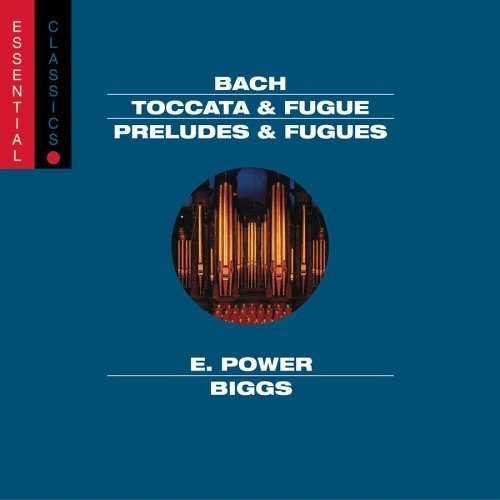
Thoughts: This starts our with easily the one of the most recognizable works of music of all time. For the first time I've learned there's some debate on whether this is actually the work of Bach, but most agree it is. What I love about this whole album is I feel Bach struck the perfect balance between tone, musical ingenuity, and emotion. I didn't feel like it was just running scales to impress with empty emotion, nor did I feel like it was pure emotion without any ingenuity, and most importantly the performance tone (and I think the way it was written) is superb - using a wide array of the "palate", but not trying to hard either. Easily the best keyboard music I've heard thus far, even if the aforementioned Scarlatti was impressive.
I've saved the best for last. Sixty or seventy years ago Biggs was well known (he even has a star on the Hollywood Walk of Fame) but, sadly, little known today. Simply put, his performances of Bach's four great Toccatas and Fugues are the best! They were recorded on the four antiphonal organs of the magnificent Cathedral of Freiburg, Germany. The Cathedral is 328 feet long with a six second reverberation time. All four organs can be controlled from a central console. What a fantastique sound; this 1971 analogue recording has not been bettered by any digital competetors. For a mere $9- you can't go wrong on this one.
RoundTheBendI miss the comfort in being sadProfile Ground Control
Era: Baroque
Years: 1735
Form: Toccata/Prelude & Fugue's, Pastorale, etc.
Score: 78
Thoughts: Not quite as funny as Mozart's Leck mich im Arsch, but pretty awesome there's a 10 movement cantata/comic opera written about a coffee addiction. Funny and worth a listen, but really nothing terribly interesting beyond that this is probably the first secular vocal work of Bach's I've listened to.
"Ei! Wie schmeckt der Kaffee süße" - aber sicher!
RoundTheBendI miss the comfort in being sadProfile Ground Control
Era: Baroque
Years: 1734
Form: Oratorio
Score: 86.5
Thoughts: Possibly the coolest thing about this is how and where it was performed. See info below. It was quite the performance and it did borrow a lot from existing melodies to fit this (learned that's called parody... which for this isn't meaning humor, rather just to mimic). "Wie soll ich dich emfangen" is a perfect example. I really liked it, but near the end I thought to myself, is this the definition of too much of a good thing? It appears maybe either Bach himself or the audience thought the same thing as this was performed only once (well, technically over six days, but not the next Christmas). Also, I suppose this was good timing. Merry Christmas everyone!
Info from Wikipedia:
These six parts were split up according to the schedule below:
The Birth
The Annunciation to the Shepherds
The Adoration of the Shepherds
The Circumcision and Naming of Jesus
The Journey of the Magi
The Adoration of the Magi
First performances:
25 December 1734: Part I – 'early in the morning' at St. Nicholas; 'in the afternoon' at St. Thomas
26 December 1734: Part II – morning at St. Thomas; afternoon at St. Nicholas
27 December 1734: Part III – morning at St. Nicholas
1 January 1735: Part IV – morning at St. Thomas; afternoon at St. Nicholas
2 January 1735: Part V – morning at St Nicholas
6 January 1735: Part VI – morning at St. Thomas; afternoon at St. Nicholas
The next performance was not until 17 December 1857 by the Sing-Akademie zu Berlin under Eduard Grell. The Christmas Oratorio is a particularly sophisticated example of parody music. The author of the text is unknown, although a likely collaborator was Christian Friedrich Henrici (Picander).
Weihnachtliche Prachtausgabe
Die Aufnahme von Bachs Weihnachtsoratorium unter der Leitung von René Jacobs gehörte bei ihrer Veröffentlichung 1997 zu den diskographischen Höhepunkten des Jahres. Kritiker in aller Welt priesen die „durchdachte Interpretation“, die „glanzvolle Besetzung“, die „Ausdrucksstärke des Evangelisten“ ebenso wie die „bezwingende darstellerische Leistung der Sänger“. Nebenbei konnte die Einspielung verschiedene prestigeträchtige Auszeichnungen gewinnen – und hat bis heute nichts von ihrer mitreißenden musikalischen Kraft verloren.
So hat sich harmonia mundi zum Weihnachtsfest 2004 entschlossen, eine luxuriöse Sonderedition dieser Einspielung herauszubringen. Um zusätzliche Texte erweitert, lädt diese Buch-CD-Ausgabe mit ihren zahlreichen Abbildungen dazu ein, Bachs musikalische Schilderung der weihnachtlichen Geschehnisse auch im Bild betrachtend zu verfolgen. Sicher wird dieser aufwendig edierte Augenschmaus für viele zum Sammlerstück, zum kulturellen Lust-Objekt.
Rezensionen
Gramophone 12 / 97: "Eine erfrischende Aufführung mit exzellenten Solisten."
HAMBURGER ABENDBLATT: "Eine quirlige, sinnliche Weihnachts-Oper.”
»Dieses Weihnachtsoratorium ist ein musikalischer Glücksfall. Hier treffen großartige Sänger, ein fantastischer Chor und ein Instrumentalensemble der Sonderklasse zusammen und vollbringen unter Leitung Rene Jacobs Außergewöhnliches.« KLASSIK. COM
RoundTheBendI miss the comfort in being sadProfile Ground Control
Era: Baroque
Years: 1734
Form: Concerto Grosso
Score: 84
Thoughts: Perfectly good, but fails to have any real flair or intrigue. The recording itself is very nice.
Info from AllMusic (Review by James Leonard)
Quote:
Rich and sonorous but robust and strong, Richard Egarr and the Academy of Ancient Music's January 2006 recording of Handel's Concerti grossi, Op. 3, is exemplary Handel playing. The Academy, of course, is long familiar with how to play Handel: it has been performing his music since being founded in England by harpsichordist Christopher Hogwood in 1973. The group's manner has been familiar to an international audience since a 1982 recording of Messiah. With an 11-piece string section, a six-piece wind section, and a two-piece continuo section, the Academy remains a chamber-sized orchestra in numbers, but a Baroque big band in practice. Led by veteran violinist Pavlo Beznosiuk, the strings are trim but muscular, capable of delicacy as well as gravity. Featuring Rachel Brown as principal flute and recorder and the dulcet oboe pairing of Frank de Bruine and Lars Henriksson, the winds add color, depth, and edge to the strings. Egarr, who has many previous excellent solo and chamber recordings to his credit, shows he can excel as a director, too, with alert tempos, flexible phrasing, and graceful ensemble. With Harmonia Mundi's fresh but warmly textured sound, this disc should be heard by anyone interested in the pieces or the repertoire.
Info from Gramophone:
Quote:
Concerti grossi, Op 3. Sonata a cinque, HWV288
Academy of Ancient Music / Richard Egarr
Harmonia Mundi HMU90 7415 (68’ · DDD).
Richard Egarr suggests that Handel might have had more of a hand in the compilation of Op 3 than hitherto identified. Fresh speculation is a healthy opportunity to reconsider matters but the truly significant aspect of this recording is the new attention brought to Handel’s charming music. It is hard to think of a lovelier moment in all of Handel’s orchestral works than the spellbinding cellos interweaving under a plaintive solo oboe in the Largo of No 2. Likewise, the immense personality of the solo organ runs during the finale of No 6 is a potently precocious display of Handel’s genius at the keyboard. All such moments come across with vitality and passion.
The AAM has never committed Op 3 to disc before: under Egarr they sound as good as ever, perhaps even reinvigorated and a few degrees sparkier. These are for the most part lively performances full of fizzy finesse. There are several fine recordings that find a little more warmth, sentimentality and intimacy in the music, although the energetic brilliance so prominent in the AAM’s crisply athletic playing has its own rewards. The musicians are unanimously immersed in the intricacies of the music, but special mention must be made of violinist Pavlo Beznosiuk’s dazzling contribution to the dynamic finale of the ‘Sonata a cinque’ (a sort of violin concerto that Handel presumably composed for Corelli in Rome in about 1707).
RoundTheBendI miss the comfort in being sadProfile Ground Control
Era: Baroque
Years: 1733 for Magnificat and 1731 for Cantata 140
Form: Marian Hymn and Church Cantata
Score: 86.5
Thoughts: This was fantastic start to finish. Great performances and powerful, yet believable musicality/tonality. I often find such vocal works a bit puffy/boring to be honest, but this one had a certain flair to it and easily came up on top for what it is. While it is fantastic, it's forms often find little place in my heart, otherwise I might give this a 90 as both compositions and recordings are indeed top notch.
RoundTheBendI miss the comfort in being sadProfile Ground Control
Era: Baroque
Years: ~1730-1740
Form: Sonatas and Fantasias
Score: 83
Thoughts: Lively and intriguing for sure. I felt more in the time if that makes any sense. The great music of Bach and Handel feel timeless to me (as many of their interpretations likely aren't as focused on being from the period). Who said the recorder wasn't serious business? Telemann's beautiful arrangements makes the recorder sound as beautiful as any modern flute, yet properly reflect the period. Though short, each piece sounds well thought out/orchestrated - each a unique work... kind of like a Minutemen album... hehe (most movements are under 2 minutes). As I listened to this, I thought, yes, his music is just as prolific as Handel and Bach. Why is he not remembered as well? And I think I've come to the conclusion that Bach and Handel wrote of the heart and I've yet to hear more than "interesting" compositions from Telemann. I mean the dude wrote something like 3,000 pieces and I've heard like 4... haha, so I'm totally judging prematurely, but that's where I'm at. Fantasia in G minor was probably my favorite on here... I felt it went somewhere other than "nice".
Info from: Archivmusic.com
Quote:
The recorder was one of the first instruments to be rediscovered as part of the growing interest in ‘early music’ at the beginning of the 20th century. "When, after about 160 years of neglect, it began to regain some of its popularity as a result of the singing movement in the 1920s and 1930s, it was largely considered to be an instrument that was easy to play and thus ideally suited to amateur music-making. However, the recorder groups of the youth music schools often deterred people from learning to play the instrument," writes Martin Elste in the booklet. As he rightly says, it was in particular the Dutch recorder player Frans Brüggen who, in the early 1960s, was able to turn the recorder into an instrument which was taken seriously among professional musicians. He not only devoted his attention to the interpretation of music of the renaissance and the baroque, on original instruments he collected, or on copies of those instruments, but also encouraged contemporary composers to write works for the recorder.
Two circumstances worked in his favour – apart from his own great musical skills, of course. He cooperated with two first class musicians who thought along the same lines in regard to the interpretation of early music, namely the cellist Anner Bijlsma and the harpsichordist Gustav Leonhardt. For many years they gave concerts all over the world and made a huge impression on their audiences. The second factor was that the record company Telefunken started its early music series ‘Das Alte Werk’. It gave Brüggen, Bijlsma and Leonhardt the opportunity to record baroque music on period instruments.
This CD presents a collection of pieces which were recorded during the 1960s and early 1970s. There is no information on the recorders used here – all treble recorders – which is a shame, since many of them are probably original historical instruments.
It is no wonder the whole disc is devoted to Telemann. He wrote many pieces for the recorder, an instrument he very likely played himself (Telemann could play many of instruments). They were part of several collections with chamber music, like ‘Der getreue Music-Meister’ (1728-29) (TWV 41:F2, B3, f1, C2) and the ‘Essercizii Musici’ (1739-40) (TWV 41:C5, d4). The Fantasias were originally written for the transverse flute, as the title says: "12 Fantasies à Travers, sans Basse" (1732-33). In his recordings Brüggen has transposed them to make them playable on the recorder. I have added the original keys in the track list.
I regret that no information is given as to when each piece was recorded. The booklet only states that 4 of the fantasias were recorded in 1969 and 1971. Listening to this CD from beginning to end, there is a clear development in the interpretation. It seems to me that the Sonatas in F (F2), B flat (B3) and d minor (d4) are the earliest. The recording of these contains considerably more noise and there is a strong separation of the left and right channel (left: recorder, right: basso continuo). The interpretation in the earlier recordings is characterised by a pretty strong vibrato in the recorder playing and relatively little ornamentation. Interestingly, though, one of the features of the continuo playing of Bijlsma and Leonhardt – the strong ‘drive’ – is already there.
Among the highlights of this collection are the Fantasias, which are played brilliantly. Here Brüggen plays with more freedom and imagination and a strong sense of the rhetorical character of these pieces. He is really telling a story on his recorder.
What is this recording all about: Telemann or Brüggen? I would say that the early recordings really can’t compete with more recent recordings of this repertoire. The Fantasias, on the other hand, certainly can. But I would like to recommend this CD above all as testimony to the art of Frans Brüggen, who not only played a key role in the emancipation of the recorder, but also – through the large numbers of pupils – had a considerable influence on the development of the historical performance practice.
-- Johan van Veen, MusicWeb International
RoundTheBendI miss the comfort in being sadProfile Ground Control
Era: Baroque
Years: 1730 (published, although written likely earlier)
Form: 3 Concertos and a Sonata
Score: 86.5
Thoughts: Very Good. Interesting to have two violins solo over the orchestra, taunting each other, in what normally only has a single soloist. Beautiful violin work, sometimes it's hard to remember it was written nearly 300 years ago, it's performance is all star and clearly a slight bit more focused on a modern violin performance, I imagine. Sometimes I hear "aged" interpretations on the viola da gamba and then a violin concerto for Bach and I'm not sure if it's a modern interpretation/performance that stands between the two or if it's that Bach and Handel really wrote such "modern" sounding music or if it's just that these dudes have created the "canon" and therefore just sound modern to my ears because they are the benchmark... idk. Good recording though :).
You cannot post new topics in this forum You cannot reply to topics in this forum You cannot edit your posts in this forum You cannot delete your posts in this forum You cannot vote in polls in this forum
 RoundTheBend