4. Oooh... Maybe PM me your Jazz recs? Do you have a listening list? I'm really wanting to not just get the top 10 or whatever, but if you have it, I'd love a listening list through time similar to this... early jazz until now. I mean not every work ever, but the "historically significant" ones similar to this classical project...
I do have a ton of lists on this site (most of which are badly in need of updating).
1. An overall jazz chart
2. Jazz charts by decade for all from the 50s through the 2010s
3. Jazz charts by year for many individual years from the 50s through the 70s
4. Jazz charts by instrument (guitar, trumpet, sax, piano)
5. Artist charts for most artists I really like who have 10 or more releases
Having been inspired by your Classical thread, I've considered doing something similar for Jazz. Knowing there is interest, I'm no more inclined to follow through and do so. I believe it will be fun, as well as further enlightening to myself as I approach a number of recordings with a fresh set of ears after having immersed myself so deeply in jazz for the last few years.
RoundTheBendI miss the comfort in being sadProfile Ground Control
4. Oooh... Maybe PM me your Jazz recs? Do you have a listening list? I'm really wanting to not just get the top 10 or whatever, but if you have it, I'd love a listening list through time similar to this... early jazz until now. I mean not every work ever, but the "historically significant" ones similar to this classical project...
I do have a ton of lists on this site (most of which are badly in need of updating).
1. An overall jazz chart
2. Jazz charts by decade for all from the 50s through the 2010s
3. Jazz charts by year for many individual years from the 50s through the 70s
4. Jazz charts by instrument (guitar, trumpet, sax, piano)
5. Artist charts for most artists I really like who have 10 or more releases
Having been inspired by your Classical thread, I've considered doing something similar for Jazz. Knowing there is interest, I'm no more inclined to follow through and do so. I believe it will be fun, as well as further enlightening to myself as I approach a number of recordings with a fresh set of ears after having immersed myself so deeply in jazz for the last few years.
Yeah! That'd be awesome!
RoundTheBendI miss the comfort in being sadProfile Ground Control
Speaking of which - I did listen to this as well and found the performances better, but the overall music deserves a revisit. She's definitely one of the better soloists and perhaps the focus was more on her... idk, what's your favorite recording of his violin concertos?
I'm afraid I don't have a lot of multi-recording knowledge. The world of Classical music is so broad and deep that were I to delve greatly into multiple recordings of works, I'd have scarce little time left over to explore jazz, blues, rock, etc., let alone all the other non-musical elements of my life. Priorities have me chasing more breadth than depth.
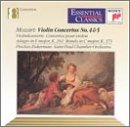
As such, I'm not familiar with a lot of recordings of the Mozart violin concertos including my favorite, the 5th. The only one I'm deeply familiar with is the one I own, a Sony Classics disc containing the 4th and 5th along with a couple very nice single movement pieces, the Adagio for Violin & Orchestra in E Major, K. 261 and the Rondo for Violin and Orchestra in C Major, K.373 with Pinchas Zukerman doing double duty both as soloist and conductor of the Saint Paul Chamber Orchestra.
I really have no idea whether it is the best or even one of the better recordings of those concertos, but it was good enough for me to take a real liking to the 5th.
Yeah, no worries, I'm in the same boat, just curious which pulled you in, and thanks for delivering. I'll see if I can find that recording.
Classical music, more than any other kind, really lives and breathes on the performance... if it sucks, then the composition suffers.
RoundTheBendI miss the comfort in being sadProfile Ground Control
Era: Classical
Years: 1777-1779 (for most of this, but some going as late as 1788)
Forms: The titles say it all
Scores: 84-86.5
I am running out of time to really talk about each one of these unfortunately, but thought I'd give an update of where I'm at:
Mozart: Bassoon Concerto / Oboe Concert...rt Academy
These were interesting as I feel like these instruments cut well as solo instruments. It's a bit more chill than your piano/violin concertos, to both their favor (more serene) demise (less memorable).
Mozart completed this work on February 10, 1785, and played the first performance the next evening in Vienna. Scoring adds a flute and two trumpets to winds, horns, timpani, and strings.
On February 11, 1785, Leopold Mozart arrived in Vienna after a wintry, bone-rattling, coach journey from Salzburg -- his first visit to the capital in 12 years and his last. On the same night he attended an Akademie by his celebrated son, who had just turned 29 and was at the peak of his popularity in ever-fickle Vienna. Leopold wrote to daughter Nannerl that, in the Casino on the Mehlgrube, he beheld "a vast concourse of people of rank.... The concert was incomparable, the orchestra excellent." After two arias by a singer from the Italian opera, there "came a new, superb piano concerto by Wolfgang, which the copyist was still writing when we arrived, and the rondo of which your brother hadn't time to play because he had to revise copies [of the orchestral parts]." This was the trailblazing D minor Concerto that survived the neglect of so much of Mozart's music during the nineteenth century. Beethoven, both smitten and influenced, played it publicly, with his own cadenzas in the first and last movements, where Mozart had improvised. No reports have survived of the audience's acceptance, but had they been hostile or even cool, surely Leopold would have reported this to Nannerl. His son's marriage without paternal permission in 1782 to Constanze Weber still rankled; so did their newfound independence. However, Papa's immediate and unreserved acceptance of Wolfgang's departures from tradition in the new concerto -- beginning immediately with an agitated, subtly changing bass line beneath the throbbing syncopation of violins and violas -- revealed a flexibility otherwise missing in his personal character. One can almost admire the manipulative Leopold for that.
In the first movement, Allegro (D minor, common time), Mozart's themes are motivic rather than conventionally melodic; more than two centuries later it remains a miracle that the soloist never plays exactly what the orchestra sets forth in the exposition, despite a rock-solid sonata structure throughout. When the piano finally enters in measure 77, it does so as an alien in a threateningly troubled land. Nor does the soloist take complete charge until the coda of the finale where, half-an-hour later, he coaxes the music into D major.
The second movement is a Romanza (B flat major, common time). Not to underrate Mozart's incomparable genius in music before this, nothing had equaled the unity of expression achieved in 1785 and after. Beyond integrating the outer movements, he made the slow movement part and parcel of the whole. This Romanza without tempo marking (but clearly Andante) is a rondo in ABACA form that plunges dramatically into G minor before the end couplet -- a significant harmonic departure not just here but in the concerto's overall context.
Mozart returns to D minor ion the third movement (Allegro assai; alla breve). Until the coda, we hear one of Mozart's rare rondos in a minor key. More precisely, it is an extended sonata-rondo (ABACDA, plus coda), since C is a development, with the reprise in section D. The development again as before in the second movement seeks out G minor -- the darkest key in Mozart's harmonic lexicon -- before D major is finally allowed to break through, albeit a whitish and wintry sun.
Wow, this recording is possibly the best I've heard so far of all of Mozarts work (and considering what I've heard so far that's quite the accomplishment). The soloists are AMAZING and the recording is fresh/has a real live vibe to it... which is often tough to accomplish.
These were interesting as I feel like these instruments cut well as solo instruments. It's a bit more chill than your piano/violin concertos, to both their favor (more serene) demise (less memorable).
I've long been a big fan of Mozart's oboe concerto. As a general rule, I'm not so keen on the clarinet, but Mozart makes me want to listen to it. As for the bassoon, that's another testament to Mozart's genius: it's generally fine as a supporting instrument, but as a solo instrument? Not many composers could have pulled that one off at all, let alone so well.
Wow, this is quite the collection... almost 10 hours of piano concertos. My favorites were 20 and 21, but in all seriousness, all 10 hours of this were worth listening to.
Any Mozart Piano Concerto is going to be worth listening to, but any one from #20 forward is going to be an absolute masterpiece (in the strictest sense, without cheapening the word one bit). My personal faves are:
#20, which starts off uncharacteristically dark and heavy by Mozart standards (kind of the piano concerto equivalent of his Symphony #40). The opening bars grip the listener and it only gets better from there.
#21, which has the most delicately melodious slow movement ever, a tune that gets used over and over again without ever getting old as well as some positively crazy virtuosity in the first movement, but being Mozart, it is the exact opposite of virtuosity for virtuosity sake.
#23, which doesn't stand out above all the others in any one particular way, yet overall, I find it to be the most enjoyable from start to finish
and #25, which is the grandest, stateliest of them all, but also includes some rather compelling mood swings.
Wow, this recording is possibly the best I've heard so far of all of Mozarts work (and considering what I've heard so far that's quite the accomplishment). The soloists are AMAZING and the recording is fresh/has a real live vibe to it... which is often tough to accomplish.
Mozart wrote the most marvelous works for the flute. What makes this even more astonishing is that he didn't personally have a great affinity for the instrument, describing it as "cold." Nevertheless, he succeeded in bringing out great warmth from it. Based on your rave, I was ready to find that specific recording, but the lineup sounded familiar... and indeed I have the exact same recording, just released at a different time with a different cover. I heartily agree, this is music worth returning to! This music is so delicate and... listenable... yet full of great richness that bears repeated listenings exceptionally well.
The flute concerto was quite inspiring. The rest was pretty good too.
Yes, he did very well with his flute concertos as well. I have a nice disc with multiple Mozart flute concertos, coincidentally with Jean-Pierre Rampal on the solo instrument, with Zubin Mehta and the Israel Philharmonic Orchestra. That said, I'm a huge fan of that concerto for flute and harp. That's no easy duo to compose for. A stunning musical achievement in my book!
What I was most impressed by this is I didn't feel like 2 or 3 piano soloists crowded each other or felt overly layered.
It's easy for two pianos to get muddy with each other, but if anyone can keep the lines clean, it's Amadeus... and he does so with aplomb. On a side note, my recording of that piece comes in a rather unusual package. It's a Channel Classics CD with the Amsterdam Mozart Players under the direction of Jurgen Kussamaul. It's slightly odd that it's paired with a symphony (#29) rather than more piano works.
But the real odd part is the filler tossed in at the end, a Concerto for Piano and Violin in D (K.315f). The 'f' at the end of the Kochel catalog number stands for 'fragment.' Mozart never completed more than 110 bars of the first movement (allegro) before abandoning the piece... or as some musicologists believe, revising it into the Violin Sonata #23 in D Major K.306. Music scholar Philip Widby completed the first movement by studying the first 110 bars and the aforementioned Violin Sonata. It's a shame Mozart never completed the concerto; I find what he did to to be delightful. Funny how a guy like Mozart is such that he can chuck into the wastepaper basket works any other composer would give an arm to be able to write!
All of these were enjoyable listens. I think I'd purposely come back to at least half of this.
I might have time for more commentary/insights/samples later.
RoundTheBendI miss the comfort in being sadProfile Ground Control
This is a great use case that encapsulates the classical movement incredibly strongly... the classical era really was a throw back to Greek and Roman times, and well this is an opera recounting Iphigenia in Tauris by Euripides. Goethe was also fond of the work and also rewrote a version... which I read but sadly don't remember much nearly 10 years later other than some play with philosophy around "what's right". While there were moments I enjoyed, and did appreciate Gluck continuing to push opera out of the near soap opera feel into a much more mature musical structure (imo) by doing things like making recitatives more musical, etc., it still didn't move me as much as his previously released opera, Orfeo Ed Euridice, even if the opening was pretty fantastic.
Quote:
Iphigénie en Tauride was one of Gluck's last operas, and the climax of his efforts to reform the French tragédies lyrique. It premiered in 1779 and was his biggest success on the Parisian stage, despite the efforts of Piccinnists to prevent the premiere. The Piccinni advocates preferred a traditional operatic style based on court idioms; Gluck's proponents favored innovation. Debate raged in the salons of Paris over the relative merits of each, and articles and letters were written in support and disparagement of both sides. But Gluck prevailed and the premiere went forward. His opera Echo et Narcisse was performed the same year but failed. The amount of work and the emotional involvement with the two operas cost Gluck his health, and he left for Vienna afterwards in a state of virtual collapse.
The story of Iphigénie en Tauride is taken from classical antiquity, and the setting is Tauris, after the Greek conquest of Troy. The libretto is by Nicolas-François Guillard and Roullet, who put together one of the finest librettos in the history of opera. The struggle is between the humanism and compassion of Iphigénie and the barbaric inhumanity of the court of King Thoas. There is no love intrigue in the plot, although the drama is filled with the conflicts of human passions. In the same time period, Goethe was writing his prose version of the story in which King Thoas is turned into a moral character, but in Gluck's libretto Thoas is so inhuman that justice is accomplished through his execution.
The opening prelude or "symphony" is sonorous and sumptuous, leading without pause into the following music The first section is full of graceful melody, but is soon replaced by an active con fuoco texture, heavy strings, and adventurous harmonies. This section leads straight into the first aria and chorus for Iphigenia, and makes for a dramatic opening to the opera. At once, a feeling of high tragedy is established. Scene 3 begins with a chorus of Scythians which uses tambourines, piccolos, and drums in an exotic texture. After a recitative for King Thoas, this same chorus returns as a refrain. A similar chorus for the Scythians for the same scoring acts as a frame in scene 4 of Act I, encompassing a ballet of four movements for the Scythians, and dramatic recitative passages for Thoas and Orestes.
The solo passages in this opera make use of a great variety of textures. Never sticking to a simple secco recitative, Gluck writes arioso passages, orchestral interjections, choral interjections, and a variety of accompaniment textures, tempi, and moods. In Act II, scene 5, Orestes and Iphigenia and a chorus of priestesses sing of the appearance of the shade of Clytemnestra in a texture which constantly varies. The emotions covered within the piece are confusion, anguish, distress, horror, vulnerability, even terror. In the scene that follows, Iphigenia and the chorus of priestesses sing to very light, flowing, orchestral accompaniment. The predominance of female voices, the flowing texture, the scoring for violins and harps, make this contrasting scene one of exquisite beauty.
- Rita Laurance, AllMusic
Era: Classical
Years: 1774, 1775ish, 1779,
Forms: Opera
Score: 85
This seemed to be a much more intriguing set of symphonies from the father of them. I think the dynamics and use of silence was key. I believe my last set was quite vibrant, but suffered from a lack of the aforementioned. These however were incredibly playful and while one could say they musically weren't much, the dynamics really toyed with something much more intriguing, yet still felt like I was skipping through the foothills of the Austrian Alps.
I have listened to, and enjoyed every last one of Haydn's 104 symphonies. It had been a while, though, since I pulled out #57, which is a wonderful piece and yet another fine example of how Haydn kept experimenting with the form in ways to keep it fresh. The subsequent movements all make their unique and intriguing contributions.
I loved the Gluck as well. Although not an opera aficionado, I may have to seek out the rest of that recording. That intro was deliciously lush and the soloist had a most gorgeous soprano. I would definitely like to hear more of her.
RoundTheBendI miss the comfort in being sadProfile Ground Control
I'm always a sucker for music with a strong cello presence. This didn't disappoint. First time I've ever heard of Stamitz and glad I had a look see. I mean it's not 100 material, but it definitely is worth a spin for discovery sake as well as a revisit. To be honest there was a bit of an influence on Beethoven if you ask me. Especially in the phrasing and the way the arrangements of brass/woodwinds and strings danced separately and then together.
I share your affinity for the Cello, and the Stamitz concertos are indeed fine examples. I agree completely, not quite elite level classics, but well worth having in the collection and listening to periodically.
You cannot post new topics in this forum You cannot reply to topics in this forum You cannot edit your posts in this forum You cannot delete your posts in this forum You cannot vote in polls in this forum
 Fischman

 RoundTheBend