The Octet is one of the pieces that drew me to Mendelssohn in the first place. As much as I appreciate his orchestral music, the Octet is still probably my favorite piece from him.
I mean, really, I love string quartets, and what could be better than a string quartet than two string quartets together 😉 ?
Yeah - his 4th and this are quite fantastic.
I think it's cool that this recording is two famous quartets who joined together to make the octet.
RoundTheBendI miss the comfort in being sadProfile Ground Control
This also is a bit akin to the Lieder Ohne Worter in that it's intrinsically romantic and is full of personal/relatable melodies. Below there's a claim this isn't marketable/relatable and perhaps that could be true, but I find this incredibly relatable. The juxtaposition and plural realities we all live in... a bitter sweet reality. Really a fantastic set of works.
AllMusic:
Quote:
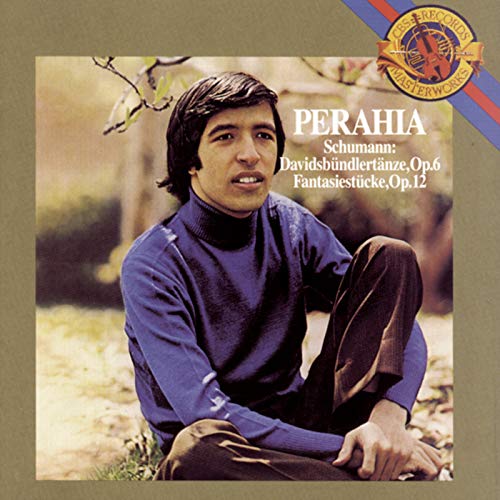
By October 1837, Schumann completed his Davidsbündlertänze, Op. 6, which was printed the same year at Schumann's expense. It was the first composition Schumann undertook after reconciling with Clara Wieck. Thirteen years later, Schumann revised the set of 18 character pieces (among other early works), making numerous changes not only to the music, but to the peripheral aspects of the score, as well.
The first edition of the Davidsbündlertänze (Dances of the League of David) contains dances composed for a group of musical friends (both real and imagined, alive and dead) that Schumann assembled around himself in support of his ideas. Reflecting the two sides of Schumann's personality, some of the dances are marked as being composed by "E." (Eusebius) and the rest by "F." (Florestan). Florestan's pieces are the more lively and exuberant; Eusebius' are more dreamy and wandering. None of the pieces has an individual title. Franz Brendel, a contemporary of Schumann who wrote some penetrating analyses of the composer's works, notes that the juxtaposition of two disparate styles "reveal to us that humor is the principle of Schumann's early compositions." These constant and mercurial changes in humor most likely made Schumann's music less marketable, and the composer himself acknowledged that the "rascher Wechsel" (rapid changes) of mood made his music inappropriate for either public or private concerts. Perhaps to prepare the performer for the work's alternating atmospheres, Schumann prefaces the publication with the proverb: "Along the way we go are mingled weal and woe; in weal, though glad, be grave, in woe, though sad, be brave." For the second edition of the work, Schumann shorted the title to Davidsbündler, but still referred to the individual works as "character-pieces." Most likely, he removed the word tänze (dances) because none of them actually works as a dance. Also, he eliminated the initials "E." and "F." from the set.
Clara Wieck appears at the very beginning of the Davidsbündler, for the dances are based on the opening measures of one of her mazurkas, which is heard in the first two measures of No. 1. The next 17 pieces are variations on this theme, with its incremental arching and emphasis on the third and fifth scale degrees.
Schumann distorts the nature of whatever dance he may be using in a piece. For example, although the first piece feels like a mazurka, with its long notes and accents on the second beat of each 3/4 measure, it does not have the expected formal characteristics. The Ländler feel of No. 2 is occasionally subverted by a compound duple meter in the melody, while the overall coherence of No. 3 is threatened when the left hand seems to get ahead of the right at several points. Schumann goes further astray in No. 6, a lively tarantella, in which he abandons the typical accents (on beats one and four) by having the right hand emphasize the third and sixth beats, the left, beats two and five. In the trio section of the piece the rhythm becomes more traditional, but there are still accents on beat six. The seven-measure phrases of No. 8 preclude its use as a dance, while No. 10, as does No. 2, juxtaposes a 6/8 meter in the right hand with 3/4 in the left.
The last three pieces are linked and suggest that B minor is the principal key of the set. Repeated F sharps connect No. 16 and No. 17, pieces of very different personalities that tend toward B minor and the ominous. After these two profound statements, the last piece, a waltz, seems anomalous.
Era: Romantic
Year: 1838 (Kinderszenen), 1839 (Arabeske), 1839 (Fantasy in C Major)
Form: Piano Works in various forms
Score: 84
This also was one of those nice listens, but didn't really fall in love with any of it/it didn't really stand out as amazing to me. Definitely worth the listen, but seemed to not pull an emotional conviction from me.
I've generally found Schumann to be somewhat underwhelming relative to his stature, so I don't listen to him often. These links reinforce my previous impression. Perfectly nice music, but for some reason, they just don't grab me.
RoundTheBendI miss the comfort in being sadProfile Ground Control
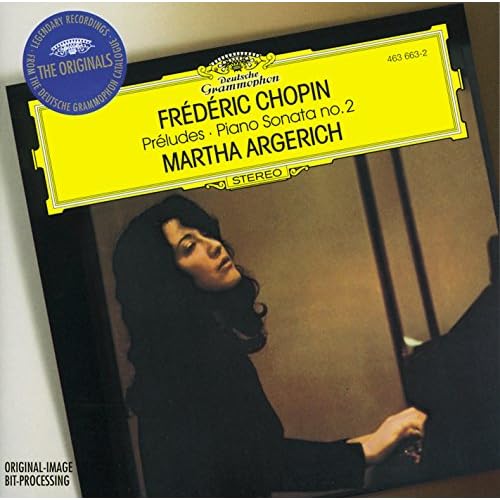
Era: Romantic
Year: Piano Sonata No. 2 in B-flat Minor "The Funeral March" -1839; 24 Preludes, Op. 28 -1839
Form: Klavierspielenmachen (just kidding)
Rating: 86
You know a lot of this romantic period journey so far I find to be really a B to B+ effort. Of course I'm not categorizing all of it as such as there's some real gems I'll get to eventually. Anyway, I really liked this one a bit more than others, but in the end if you don't like something, then it doesn't matter if the thing itself is garbage or not. This album falls in this category. And it could be the piano really takes off and that's just the thing right now, so I'm a bit inundated with piano music... dunno. But both works are good, but I didn't fall in love either...
RoundTheBendI miss the comfort in being sadProfile Ground Control
I've generally found Schumann to be somewhat underwhelming relative to his stature, so I don't listen to him often. These links reinforce my previous impression. Perfectly nice music, but for some reason, they just don't grab me.
Doh - I thought I responded to this.
I did find this recently though and is possibly my favorite Schumann record thus far. It's not saying much though because I agree that Schumann is pleasant and all but doesn't really stir me up.
Those who criticize Robert Schumann for not grasping the depths of meaning in the poems he sets perhaps could be accused of engaging in a shallow reading of the lied composer's musico-poetic sensitivities. In fact, some scholars argue that Schumann's subtlety -- his ability not only to render texts, or even interpret them, but also to comment on them with tones -- is the very essence of his song style. When hearing his 1840 collection, Dichterliebe (The Poet's Love), one must not only look for correspondences between poetic image and musical figure, but artistic incongruities, as well -- moments where Schumann steps back from the verse, takes a critical stance, and engages with the poet on equal and sometimes even contradictory ground.
Widely considered his best song cycle, Dichterliebe was composed within a matter of days -- amazingly, during the same month as Schumann's Op. 24, Liederkreis. Dichterliebe takes for its texts 16 poems from the "Lyrisches Intermezzo," a section of Heinrich Heine's Buch der Lieder from 1827. (Originally, Schumann's cycle included 20 songs, but four were omitted when Dichterliebe was published as Op. 48 in 1844.) Heine's group follows a trajectory of increasing irony. The opening poems express an innocent hope that the speaker's love will be reciprocated; the first two selections, Im wunderschönen Monat Mai (In the Wonderful Month of May) and Aus meinen Tränen spriessen (Springing From My Tears) both feature the optimistic imagery of springtime blossoms budding and birds singing. From the beginning, however, Schumann hints at a less favorable outcome. While it is not an uncommon device for Schumann to end the vocal line hanging on a dissonant chord, leaving the piano to carry out a song's conclusion, Im wunderschönen Monat Mai ends even more ambiguously. The song itself ends ethereally on an unresolved chord, suggesting that the singer's love may remain unrequited. By the fifth song in the cycle, the speaker's thoughts of his lover have already slipped into the past tense; the seventh song, Ich grolle nicht, takes on a decidedly ironic tone. A sturdy bass line supports a repeated chordal texture, while the singer's line assumes a regal, almost heroic air. The text, on the other hand, feigns austerity in order to veil its suffering: "I saw you in a dream/and saw the darkness trapped in your soul/and saw the serpent that gnaws at your heart./I saw, my love, how miserable you are." Schumann's overblown accompaniment makes it clear that it is the speaker, not his beloved, who is miserable. By the end of the collection, all pretense is gone, and the speaker's tone is jaded. Schumann's music is likewise plodding and unrelenting in its rhythm and figuration, and even more unrelenting in its dark parody. Triumphant ascending arpeggios break briefly into the major mode, only to find a sardonic answer in minor once again. Curiously, however, as the singer's final, sorrowful strains fade, a bittersweet piano postlude offers a sense of repose found nowhere in Heine's original.
This I actually enjoyed a bit more. I don't know if it was because it was a thicker instrumentation (instead of the onslaught of piano works I've been doing), or lively, etc. It kind of fits more my serious, yet accessible aesthetic I typically enjoy more than trombone vomits that are "unique" and so therefore more artistic type bullshit that just isn't true. Anyway, it was energetic/pleasant and passionate... so I liked it. Best thing ever... no.
Quote:
The ballet Giselle, although generally identified with the name of composer Adolphe Adam, was the creation of French poet and novelist Théophile Gautier (1811-1870). Gautier was inspired by a poem in Heinrich Heine's book De l'allemagne that recounted an Eastern European legend of the Wili (or "wally"), the soul of an unmarried girl who has died before her wedding day and who dances in the forest for all eternity and drags unfortunate men to their doom. Gautier immediately envisaged the work as a ballet but had no experience in plotting one. For this he turned to dramatist Vernay de Saint-Georges, who worked out a proper scenario from Gautier's ideas.
Rather than presenting the work cold to the director of the Paris Opéra, Gautier showed it first to Jules Perrot, then mentor to a ballerina, Carlotta Grisi, who had made her Paris Opéra debut just weeks before. Grisi liked the scenario, and both she and Perrot lobbied successfully to have it produced, but on the condition that it be ready by June 1841 -- in less than a month. Fortunately, Perrot had already contacted composer Adolphe Adam, known for his ability to cook up a quick score in a short time. Adam had begun work on April 11, before the ballet was approved. The work was finished on June 8, 1841, a mere 20 days before the production was launched.
Giselle was more than a mere success; it is credited with "inventing" Romantic ballet as we know it. Its tragic theme of the heroine doomed to dance forever was re-created subtly in countless ballets afterward. The very stage costumes of the Wilis -- tutus and tights -- marked the introduction of standard ballet apparel. Adam's music is serious in nature and not frivolous; even played uncut with all the repeats intact, Giselle is anything but monotonous. The first act sparkles with charm and grace, and is packed with strong, memorable melodies. The second act, with its more sober dramatic content, is often brooding and mysterious, yet still maintaining the rhythmic lilt of the first. It is Adam's finest theatrical creation outside of his opera Le Postillon de Lonjumeau.
Grisi gave performances of Giselle at the Opéra for years afterward, and the ballet was staged in Paris as late as 1868. By then Perrot had moved to St. Petersburg and was choreographer for the Imperial Ballet Theater. He made Giselle a staple of the Russian company, and after Perrot's retirement Marius Petipa retooled the choreography, creating the basis for the standard Giselle that is seen today. The most celebrated Giselle given under Petipa's direction was his last revival of the work in 1903, featuring the dynamic and now-legendary ballerina Anna Pavlova.
Some additions to the score are considered standard. Léon Minkus may have added the waltz variation that replaces Adam's original in the first act, and no one knows how another waltz variation of the first act's love music wound up added to the second act. However, these changes are strictly observed in present-day performances.
Era: Romantic
Year: 1842
Form: Incidental Music
Score: 86
As a complete work, it's nice and all. Shakespeare and ok accompaniment. Nothing special and nothing not good. The overture was pretty good and then there's the famous wedding march. Again, nothing I'd be begging to come back for, but it's moments are pretty good. If I were using my true song for song scale, it'd actually probably get something like a 75.
Quote:
Mendelssohn's incidental music for A Midsummer Night's Dream, Op. 61, was completed 16 years after he wrote the Overture, Op. 21. The consistency of style and musical unity between them belie the disparate dates of composition. The overture was by an incredibly musically gifted youth of 17, and the incidental music was by the music director of Prussia's King Friedrich Wilhelm IV's Academy of the Arts and the Leipzig Gewandhaus Orchestra.
A Midsummer Night's Dream had always been a favorite of Felix and his sister, Fanny. The commission for the remaining music came from the King, for a Potsdam production of the play, one of several commissions for theatrical music Mendelssohn received while in this post. The producer of the play was Ludwig Tieck, one of the translators of the definitive German version of the play, the same version that the Mendelssohns had enjoyed and absorbed thoroughly as their own.
The incidental music consists of 14 sections, including the overture. There are vocal sections and instrumental movements. The vocal selections include the song "Ye spotted snakes" and the melodramas "Over hill, over dale," "The Spells," "What hempen homespuns," and "The Removal of the Spells." The melodramas served to enhance Shakespeare's text. The remaining sections are primarily cues. The music combines the traditional forms and structures of Classical music with the feeling and expression of the Romantic era. Throughout the sections, Mendelssohn sprinkles themes and motives pulled from the earlier overture to create coherence.
The instrumental movements, Scherzo, Intermezzo, Notturno, and the "Wedding March," are usually excerpted with the overture for orchestral concert performance. The Scherzo appropriately introduces the fairy-world of Act Two with rapid, running passages in the woodwinds, similar to the string passage in the opening of the overture, both set in a minor mode. The rest of the orchestra joins the woodwinds in a Classical sonata-form movement. Several small motives are repeated, up and down, then down and up the scale, to form the development section. The Intermezzo represents the confusion encountered as Hermia awakes, with a swirling melody buffeted about by the orchestra. The rustic players enter jauntily, represented by the bassoons and ending the Intermezzo in the major. A German Romantic horn melody is the theme of the Notturno. The music evokes the dreams of the couples as Puck puts right his previous mischief. The "Wedding March" opens with that oh-so-familiar trumpet fanfare, fitting for the Duke of Athens' wedding. Two trio sections are separated by the opening theme; the final occurrence of the main theme includes twittering flutes and strings, suggesting the fairies' part in the matchmaking. The "Finale" returns to the overture for most of its sparkling material, ending with the same four woodwind chords that begin the entire work.
Although some consider Mendelssohn's work to be lightweight and uninspired, the entirety of A Midsummer Night's Dream proves otherwise in its inventiveness in reviving his older material and in its expression.
I was less impressed with this for some reason. Listened to it twice and I either am not on the right wavelength, or this is a lesser work, even if not bad.
RoundTheBendI miss the comfort in being sadProfile Ground Control
I found the background to this symphony more interesting than the symphony itself. Mature in sound, it does have a nice soundscape, but overall it's underwhelming to me.
Quote:
Mendelssohn's Symphony No. 3 in A minor, Op. 56, is the last symphony the composer completed. Mendelssohn's letters show that his first inspiration for the symphony came in 1829, during his first visit to England. After some sketching, Mendelssohn set aside the piece until 1841, when disappointments in his life placed him in a mood similar to that he experienced in England 12 years earlier. The early conception and sketching may account for the squarness of some of the themes. The piece was completed on January 20, 1842; it was first performed on March 3, same year, in Leipzig, and was published in 1843. After a successful performance of the symphony in England in 1842, Mendelssohn received permission to dedicate it to Queen Victoria.
Each movement is to move immediately to the next without pause, setting it apart from Mendelssohn's other symphonies. To the tempo markings of each movement Mendelssohn adds directions reflecting the character of the music, which conveys Mendelssohn's impressions of the Scottish landscape.
Opening with a restrained, Haydn-esque slow introduction, the first movement moves suddenly to an Allegro un poco agitato tempo with a main theme that is treated with variation technique. The orchestration is among Mendelssohn's most dense; curious and exhilarating modulations open both the development section and coda. The development section is concise and effective. When the main theme returns in the recapitulation and the introduction returns in the coda, the themes are underpinned with a counter-theme in the cellos. The coda also contains the famous chromatic "wave," played by the strings.
The cheerful Scherzo, marked Vivace non troppo, is derived from Scottish folk music, which is a surprise, since in 1829 Mendelssohn complained that such sounds gave him "a toothache." It stands in stark contrast to the thick first movement and is in sonata form. The movement fades and dissolves to prepare for the ensuing Adagio.
Resignation reigns in the third movement, an Adagio cantabile in A major. A clear reference to Beethoven appears in the low strings, which play a motive resembling the theme of the Allegretto of Beethoven's Seventh Symphony. Reminiscences of Beethoven's Op. 74 String Quartet also appear. Beautifully orchestrated, the movement is in two major sections separated by returning material.
Folk melodies appear again in the Finale, an unusually powerful and militant movement for Mendelssohn. A leaping, aggressive theme in the violins begins the movement, appropriate for Mendelssohn's direction, Allegro guerriero (Fast and warlike). Fragmentation technique propels the development section as themes are layered and treated contrapuntally. After the recapitulation we do not hear a coda with thematic references to the exposition. Instead, Mendelssohn shifts to a Maestoso coda, in which we hear new material and the theme from the introduction, which is again taken through variations and now conveys an air of triumph after the "battle." The symphony closes in A major.
You cannot post new topics in this forum You cannot reply to topics in this forum You cannot edit your posts in this forum You cannot delete your posts in this forum You cannot vote in polls in this forum
 RoundTheBend


 Fischman