This is a great collection of Stockhausen's early musique concrète works. Along with John Cage and some others, this is an incredible time in music history; pushing musical boundaries to as many limits as can be found. While this is a decade before space exploration, many connote these works alongside space discovery/"sounds like stuff from space". Easily top electronic music album for me. Somehow he makes these explorations so intriguing and relatable. No shitting on the saxophone here and calling it music, rather an intriguing discovery of boundaries. Gesang der Jünglinge has an interesting juxtoposition of a "church" choir boy singing a part of a hymn against well... sounds and probably is the most "accessible" - but really all of this is great stuff playing with sounds that aren't annoying.
Quote:
Gesang der Jünglinge, for electronics & taped boy's voice
Description by Edward Moore
Karlheinz Stockhausen's Gesang der Junglinge (1955-1956) has long been recognized as one of the touchstones in the history of electronic music. The means Stockhausen used to produce and record this work are in themselves remarkable, involving the most sophisticated studio equipment of the era. Utilizing a four-track tape recorder and four separate loudspeaker systems, the composer set out to achieve the unification of vocal and electronic sounds to generate a musical landscape in which his imagination, no less than the listener's, is "freed from the physical limitations of any one singer" or set of instruments.
The dominant technique in the production of Gesang der Junglinge is that of musique concrete, wherein "extra-musical" occurrences are utilized as a formative or limiting context in which the actual musical event can take shape. In this case, such occurrences are electronically generated sound waves and white noise. It is within this sonic spectrum that Stockhausen arranged the electronic sounds and the sound of a boy's voice into what he has referred to as "a speech continuum," a scale between the extremes of intelligible speech and seeming nonsense.
The work's text is taken from the "Song of the Three Youths" in the Book of Daniel, in which Daniel's companions praise God for rescuing them from the fiery furnace. The symbolism of the biblical tale -- the emergence from death into life -- is expressed in Gesang der Junglinge by the dramatic formation of often incomprehensible vocal sounds into articulate words and phrases. In remarks made before the 1956 world premiere at West German Radio in Cologne, Stockhausen stated that "whenever language emerges momentarily from the sound signals of the music, it praises God."
The guiding ideal of this piece is Stockhausen's conviction that composing should not involve simply the arrangement of musical sound, but both the "composition of sounds themselves" and the "synthesizing of the individual sound." The result is more than just a musical moment or monument; it is the representation of the very emergence of music from the disorder of raw sound.
Kontakte, for piano, percussion & electronic sounds
Description by Alexander Carpenter
Kontakte (1959 - 60) marks the end of Stockhausen's first compositional period, which was most notable for the composer's experiments with numerical serialism. Despite the given date of Kontakte's composition, Stockhausen actually began work on it in 1958, but was delayed in part by having to share the electronic music studio in Cologne with fellow composers György Ligeti and Mauricio Kagel, both of whom were similarly working on large-scale pieces. Like so many of Stockhausen's works, Kontakte exists in more than one version. There are, in fact, two: the first, No. 12 in the composer's catalogue, is a purely electronic composition on tape; the second, No. 12 1/2, is for electronic sounds, piano, and percussion. This second version is particularly important, as it is Stockhausen's first work to combine electronics and live performers.
In the late 1950s, Stockhausen became increasingly influenced by the aleatoric music of American composers like Morton Feldman and John Cage, as well as by American jazz. These influences are evident in Kontakte, though it is a work that clearly belongs to the European avant-garde tradition. It also presages developments in Stockhausen's own style, including elements -- such the addition of instrumentalists to an existing tape composition -- central to his later works.
The title refers to the moments of "contact" between the electronic sounds on the tape and the live performers. The tape consists of percussion sounds altered by different electronic means, including a ring modulator, a reverberator, and an impulse generator. The instrumental parts intertwine with the taped sounds, creating a wildly diverse array of textures and timbres over the course of six sections, or "moments." The moments are determined by events on tape, but the instrumentalists also participate in the transition from one moment to the next by changing character. Each moment contains six subdivisions of intensity, from "just noticable" to "violent," that refer to variations in acoustical phenomena including volume, speed, and register. The pianist and percussionists must respond and interact carefully with the tape, ensuring a proper balance of dynamics and intensity.
While Kontakte has a quasi-improvisational feel, the instrumental parts are written out in full. In his original conception of Kontakte, Stockhausen had envisaged a piece in which performers would respond freely to the events on tape; however, initial rehearsals were, in the composer's own words, "a real disaster. The musicians did not know what to do." Ultimately, Stockhausen expressed displeasure with Kontakte, and, as in the cases of so many of his other compositions, regards it as unfinished.
I've seen this album from you or Gabe once or twice. I really should give it a spin.
Also... I'm really curious as to your idea of why Stockhausen is often considered part of the "classical" realm, but many other electronic music pioneers "aren't". I think it has to do with who Stockhausen studied/worked with to be honest, but was curious on your take.
It's like the comment is sometimes made that Norman Rockwell is not a real artist. 🙄 I mean I understand the argument my museum curator friend makes, but really...
RoundTheBendI miss the comfort in being sadProfile Ground Control
Every time I start to think I might start getting bored, something fascinating happens.
Right?
My favorite thing about Stockhausen is I feel like he's a master of intrigue. It's (as I've said) not shitting on a saxophone begging for your attention, rather masterfully curating a sound that is intrinsically intriguing.
I would say that weird classical people probably gatekeep more than any other kind of music lover, so I wouldn't be surprised that they have a thin line between what they would consider to be part of the canon and what's not. I would say that any artist that approaches music from a composition first standpoint would make sense to be a part of the same group of artists in the past. But as soon as music became purely electronic it certainly became a different beast alltogether.
As for Norman Rockwell not being an artist, which is a ludicrous notion, I think that his populist and commercial image has overshadowed the actual satire and truth in his work. It's often said that he painted an "idealized version" of American life, but that only applies to some of his work. Ever heard of "Murder in Mississippi"?
I would say that weird classical people probably gatekeep more than any other kind of music lover, so I wouldn't be surprised that they have a thin line between what they would consider to be part of the canon and what's not. I would say that any artist that approaches music from a composition first standpoint would make sense to be a part of the same group of artists in the past. But as soon as music became purely electronic it certainly became a different beast alltogether.
As for Norman Rockwell not being an artist, which is a ludicrous notion, I think that his populist and commercial image has overshadowed the actual satire and truth in his work. It's often said that he painted an "idealized version" of American life, but that only applies to some of his work. Ever heard of "Murder in Mississippi"?
Yeah basically. Also I didn't mean just "any" museum, rather the Getty or Guggenheim, etc. And to be honest in 10-20 years it could be/and more than just a visiting exhibition for a week or two.
I guess the argument was made that Rockwell was an artisan not an artist... it's almost like they make this decision of true artistry based on economic factors... which gets confusing because "real" artists had to work off commissions and the such too... dunno. Often a "real" artist was like John Cage who had a lifelong allotment given to him for his artistic endeavors.
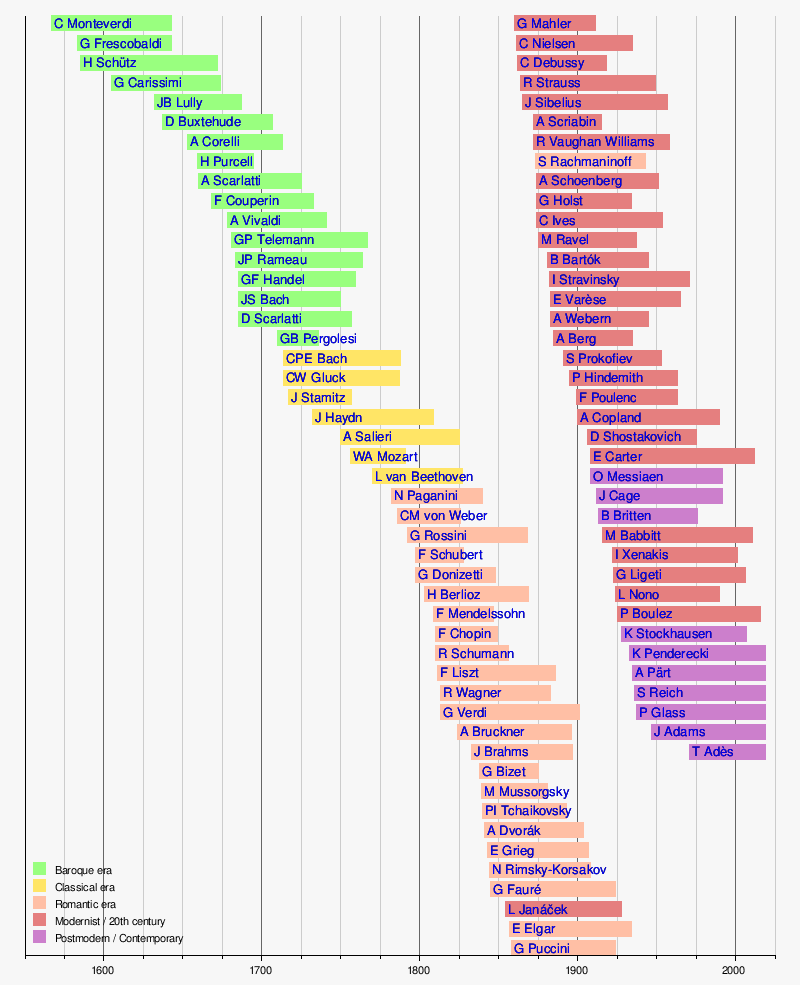
Whatevs... was just curious on why when you get the "fifth grade answer" on things, it looks a lot like this wikipedia page which lists Stockhausen, but not really Pierre Henry or many others. Stockhausen rubbed shoulders though with a chunk of modern artists on the "fifth grade answer" though... so that's the only thing I can think of as to why he makes the "simplified fifth grade answer" to modern music composers.
Thumbnail. Click to enlarge.
RoundTheBendI miss the comfort in being sadProfile Ground Control
I actually liked this way less. It might be because I was distracted working in the yard and likely would have a different effect live. What I heard was more annoying flute noises... when I read what's below I wonder if I even listened to the right thing (but what's pictured and linked I did indeed listen to... so... anyway, I'm just an idiot). It was of course random noises, but that was expected. It was the silence that drove me crazy (which is indeed the genius of it).
Quote:
Fontana Mix, for 4-channel tape or indeterminate means
John Cage's 1958 title Fontana Mix is attached to two related, but historically distinctly separate, entities, the score published by C.F. Peters (1960) and the four multi-channel tapes Cage prepared from it at the Studio di Fonologia in Milan. The score Cage created for Fontana Mix consists of 20 sheets, ten transparencies inscribed with points (or dots), a single transparency bearing a straight line and ten plain white sheets with squiggly lines. By means of an included graph and a straight line, the performer uses the sheets in combination as a "tool" to assemble a realization of Fontana Mix. In executing the tape, Cage divided his sound sources into six classes; city sounds, country sounds, electronic sounds, manually produced (meaning "instrumental") sounds, wind-produced sounds (such as singing), and small sounds that require amplification, such as crickets chirping. Coordinate points drawn from the transparencies determine the class of each tape sound, inches of tape used, its volume, timbre, mixing, and other elements. Cage once described the score of Fontana Mix as "a camera from which anyone can take a photograph."
The creation of the four audio tapes comprising Fontana Mix were not created without some difficulty. The tapes were not coming out to the same coordinates as the score, and the problem wasn't solved until Cage realized that he was editing with both eyes open and that his Italian second engineer was cutting with one eye closed. The difference in tape inches proved sufficient to throw the whole work off the plan.
Both the score and tape of Fontana Mix provided Cage with a rich source of variables from which to garner new pieces. A cycle of Cage works emerged in the years 1958-1960 that either draw information from the Fontana Mix score or make use of the tapes; Aria and Music Walk (both 1958), Sounds of Venice and Walter Walk (both 1959) and Theater Piece (1960). A 1960 Time 2000 series recording of soprano Cathy Berberian combining Aria with Fontana Mix is a frequently cited example, chosen to exemplify Cage's compositional efforts in this period. Likewise celebrated is Cage's 1959 Folkways recording of Indeterminacy, where David Tudor once again pressed the Fontana Mix tapes into service behind Cage's droll narration of 90 short stories. Cage has also suggested that Fontana Mix may be used in conjunction with Solo for Voice 2 (1960) and Songbooks (1970).
Long after their creation, the Fontana Mix tapes continue to inspire audio artists within the field of electronica. There is a group called Fontana Mix in honor of Cage's creation and the group the Tape-Beatles has recorded a "Euro-pop dance mix" of the work. Other significant realizations of the score as published include the 1964 Max Neuhaus version for electronic percussion entitled Feed, a later (1967) Tudor/Cage version scored for piano and electronic circuits and an audio-architectonic environment (1998) created in Stuttgart, Germany by artist David Wendland.
After listening to some stuff on youtube... I likely have a shit recording:
If you want to hear a completely different side of Cage, then you should listen to the compositions on this album. Strictly minimal Satie-inspired solo piano with no gimmicks.
You cannot post new topics in this forum You cannot reply to topics in this forum You cannot edit your posts in this forum You cannot delete your posts in this forum You cannot vote in polls in this forum
 RoundTheBend


 Tha1ChiefRocka

 Fischman