True love at first sight while playing Sid Meier's civilization... and other things that make sense to people/emotive responses... blah blah... is it nap time yet?
Quote:
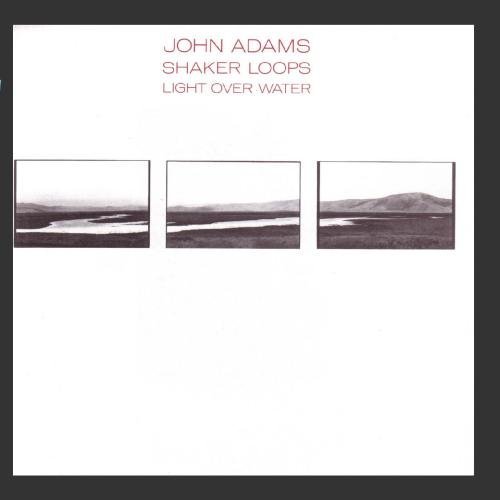
Shaker Loops, for 7 strings or string orchestra
Description by Chris Morrison
From 1972 to 1982, John Adams worked at the San Francisco Conservatory of Music. As head of their new music program, he conducted the Conservatory orchestra and new music ensemble and taught various classes. Adams found the constant interaction with musicians stimulating, particularly his students' reactions to his compositional ideas. To create Shaker Loops, which he regards as one of his first truly characteristic pieces -- and one of the first in which he used the repetitive style known as minimalism -- he used some material he had created for a string quartet called Wavemaker. Dissatisfied with the material, Adams rewrote the music for septet (three violins, one viola, two cellos, and one bass), creating what he called a "modular" score. The loops mentioned in the title are melodic patterns of different lengths that are distributed among the seven instruments and that interact and overlap in various ways. Changes in the patterns are signaled by a conductor. In this form, Shaker Loops was premiered in 1978, by the San Francisco Conservatory's New Music Ensemble under Adams' own direction. He eventually created a through-composed version of the work that doesn't require a conductor. In 1982 and 1983 he also adapted the work for a full string orchestra.
The Shakers referred to in the title are the members of the United Society of Believers, the famed New England-based religious community known for their ecstatic dances of worship (or "shaking"). Adams grew up near an old Shaker community in New Hampshire, and he drew a connection between the shaking and a quick movement of bow across string that marks much of this composition. The work is in four movements, played without pause. The propulsive, almost locomotive-like motion of the first movement, "Shaking and Trembling," forms quite a contrast to the almost static second, "Hymning Slews," with its long slides (or glissandi) over a bed of longer, sustained tones. The mood here is hushed, and the third movement, "Loops and Verses," extends this mood with its simple yet haunting cello lines leading the way. But more agitated music emerges and gains momentum, culminating in what Adams has called a "wild push-pull section" of considerable force. A cloud of pulsating harmonics leads to the energetic fourth movement, "A Final Shaking."Shaker Loops has become one of Adams' most frequently performed pieces. It has also been choreographed several times, and a portion of the first movement was used, albeit briefly, in the 1987 film Barfly.
Quote:
Light Over Water, symphony for brass & 2-channel tape
Description by Jeremy Grimshaw
Commissioned in 1983 by the Los Angeles Music of Contemporary Art as part of a collaborative work with choreographer Lucinda Childs and set designer Frank Gehry, Light Over Water represents much of what lends minimalism so easily to utilization by other artists. The three-part work for brass and synthesizers begins expansively, with low, long-held tones in the brass reminiscent of Strauss's Also Sprach Zarathustra. These tones don't build into Strauss's thunderous proclamations, but rather give way to a pulsating web of electronic sounds. The ear (and presumably the movements of the dancer) can ride smoothly on the surface of the sound, or dive into its rhythmic intricacies and pull them to the surface. The second movement begins with simple repeated chords in the synthesizers, which are gradually overlaid by other rhythmic figures. These figures gradually fill in all the available "holes" in the rhythmic composite, again creating a shimmering web whose individual components become almost indistinguishable. Textures move smoothly from foreground to background with hypnotic effect, each of the widely-spaced harmonic shifts altering the overall stasis with nearly undetectable nuance. The third movement begins with what sounds like a far-off chorus of crystal glasses. Brass and sustained electronic tones slip in and out of earshot. The electronic sounds, gradually over the space of several minutes, become more percussive, the rhythmic figures more discernable. The instrumental colors come into sharper focus, the contrapuntal web being constructed of increasingly smaller and distinct points and lines. The piece ends then as it started, with determined held tones holding out over insistent rhythmic patterns, the sustained tones finally prevailing.
Perhaps partly due to its collaborative conception, Light Over Water does not seem particularly representative of Adams's output, even in the early 80s. Absent are the intermittent points of impact that happily disrupt the smooth musical surface of so many of Adams's other works, and its meditative nature goes largely undisturbed. The shifts of harmony and meter almost always occur in piecemeal fashion, and the rather primitive electronic sounds available to the composer in the early 1980s date the piece quite pointedly, almost to the point of caricature. In fact, Light Over Water represents a stylistic extreme from which Adams, would quickly depart.
Wasn't crazy about this, but totally worth the listen. Like it was almost there for me... probably my mood. I feel like there were some samples here that were purposely messed with. Kinda fun concept, but wasn't jiving with me at the moment.
A.Schnittke - Concerto for Piano and Strings (1979)
Era: Contemporary
Year: 1980s
Score: 90 (I guess- ha)
Glass and Adams have this unique ability to be like disney or something. I don't know how to explain it. They do a similar thing as everyone else, but the tones used are often a little less soulful, but having said that I really still like it somehow. Another memorizing minimalist set of works, like ants crawling kinda thing. Stuff and words. I think I liked Floe the most.
Quote:
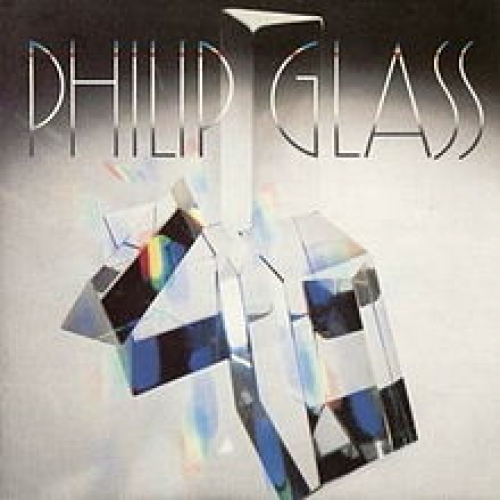
AllMusic Review by John Young
The usual stuff is here: arpeggio versus ostinato, ostinato versus arpeggio. And as always, the Philip Glass Ensemble's synthesizers double their woodwinds. But Glassworks is the most pleasant craftwork ever from the great minimalist exploiter -- six warm pieces that approach the spirit of minimalist pioneer Erik Satie. Only instead of Satie's lyrical-to-antic jumps, Glass creates the ruminative-to-excitable kind. "Opening"'s softly rolled piano melody is music to fold your hands and muse by, and when Sharon Moe's French horn sets up "Floe," everything seems nice and level -- until the flailing woodwinds and synthesizers of the ensemble crash in. Glassworks is tuneful in the most pleasingly direct sense -- the arrangements define the melodies so cleanly they're instantly memorable. In addition, the album is programmed with a particular shape in mind. It's kind of a waveform, where every other relaxed melody is upset by a classic Glass rush -- "Floe" is even outpaced by "Rubric"'s honking saxophones and enough cascading counterpoint to give David Helfgoff a case of carpal tunnel syndrome. These two tunes are so disruptive, so complex, that it's easy to think that they dominate the whole project. But they're also the shortest tunes on the album. Most of the time, harmonies bob around in the strings and woodwinds, though Jon Gibson's soprano sax glides atop "Facades." "Closing," based on "Opening" (funny), contains his second prettiest orchestration after the finale of Satyagraha. In fact, it's probably the source of Glass' subsequent reputation in the new age music industry. Of interest to those who keep up with Glass' re-use of his work: "Rubric" was originally intended for use in Godfrey Reggio's movie Koyanisqqaatsi. It was re-used along with "Facades" on the 1987 album Dancepieces. "Opening," "Floe," "Facades," and "Rubric" were performed in Peter Greenaway's film 4 American Composers, devoted to Glass and his ensemble; in this performance segment, Dora Ohrenstein's vocals replace "Floe"'s brass section.
Lots of interesting stuff there. Too swamped to listen/comment at the moment. I look forward to getting caught up.
Yeah no worries mate - thanks for joining me on most of this ride. It's been fun to see your commentary when you can, but I totally understand when that's not an option.
Here's another whiplash of stuff. I'm actually on a roll because I'm so close to being "done" with this listening project and am excited to get all the way to 2017. The last hundred years could probably have a deeper dive, but couldn't everything... hehe. It's an ok start and I've never been one who "has" to know it all - I'd rather enjoy a few.
I didn't find much I wanted to come back more for on this one. nuff said. I 'll let this guy go on instead:
Quote:
Trio for horn, violin & piano ("Hommage à Brahms")
Description by Robert Kirzinger
Ligeti's Trio for violin, horn, and piano was completed in 1982 and premiered on August 7 of that year. Apart from some smaller works, including Hungarian Rock (chaconne) and Passacaglia ungherese for harpsichord, Ligeti had composed very little since completing Le Grand Macabre in 1977. The extreme eclecticism and physical scope of the opera seem to have cast the composer into a compositional crisis: what does one write when one has just finished writing everything? As many composers before him had done, Ligeti turned to music history and other musical cultures for an answer. Though Ligeti had never been averse to history, his more explicit turn in that direction is reflected in the chaconne and passacaglia forms in the 1978 harpsichord pieces and in the final scene of Le Grand Macabre, which itself is a passacaglia. In the late 1970s and early '80s, Ligeti gained inspiration from many sources, but most particularly from study of sub-Saharan African drumming and from research into fractal procedures in mathematics. In 1980 Ligeti also discovered the music of American expatriate composer Conlon Nancarrow (1912-1997), whose multi-layered, complex studies for player piano closely paralleled Ligeti's rhythmic interests at the time.
Ligeti also became interested in the music of Chopin and Schumann, particularly in their use of rubato and hemiola (a subverting of the predominant rhythmic pattern with a different division of the beat). The idea of a melodic line carrying its own distinct rhythmic burden became one of the main concerns of the Trio for violin, horn, and piano. Ligeti had another, even more specific influence in the horn trio of Brahms Op. 40 (1865). Ligeti's musical language, having emerged from the vex of a writer's block, is paradoxically purified and direct in its presentation of ambiguous rhythmic cross-relations and skewed harmonic clichés, such as several versions of the common "horn fifths" motif. In the first movement the violin and horn engage in a duet of two tempos, but the relationship between the two is relatively exact. The horn is the main melodic instrument, soaring in high, fast runs. In spite of the apparent complexity of the melodic language, the harmonic profile of the movement, and of the piece as a whole, is surprisingly diatonic. After the circumspect first movement, the motoric but dancing rhythms of the second and third movements show the results of Ligeti's knowledge of the musics of Africa and the Caribbean, and of Nancarrow. The second movement is in an eighth note pulse that is further subdivided into groups of three plus two plus three. Ligeti manipulates the groupings of this pattern to produce seemingly different tempos among the three instruments, a technique he took even further in the Six Piano Études of the following year. The third movement begins with a stuttering rhythmic unison that gradually goes out of phase. A lyrical, legato section succeeds this material with differing phrase lengths among the instruments. The final movement is a lament based loosely on the sorrowful, descending funeral chants of several Eastern European cultures. Again, the varying phrase lengths are an important expressive aspect of the music.
The Trio for violin, horn, and piano led directly to the Études for piano, Book I of 1985 and to the Piano Concerto of 1985-1988. Portions of all three works share virtually the same concerns, and reuse very specific gestures and modes of expression, just as Ligeti reused those ticking clocks and harmonic clouds throughout his earlier music.
Man this was great. Thanks for the rec Fischman! It only took me weeks/months to get to it... hehe. It felt like a journey to pre explosion beauty of Mount St. Helens and then in the 3rd movement it did what you'd expect -exploded. Although I will say I've heard more explosive arrangements, so maybe I set myself up for too high an expectation when I thought - huh, I thought the whole point was explosive symphony. Still great though, really just expected more. But really was explosive- you know it's like the fireworks show you go to and thought it was going to be better and then you realize dude, chill out man, that was a great fireworks show - just because you didn't singe your eyebrows doesn't mean it wasn't... 🤣
Quote:
Symphony No. 50 ("Mount St. Helens"), Op. 360
Description by Joseph Stevenson
As is the case with most of his works, Hovhaness' Symphony No. 50 is dominated by long, Eastern-influenced melody, dance music of the Himalayas and Caucasian mountains, and evocations of Chinese, Korean, and Japanese art and music. But it is the image of the mountain, Hovhaness' most enduring fascination, both literally and figuratively, that takes center stage here -- in this case, Mount St. Helens. Hovhaness reportedly witnessed the great volcano's 1980 eruption, and over the course of its three movements, this symphony attempts to capture the serenity of the location before that event, the violence of the eruption itself, and then finally the miracle of creation that volcanism represents -- the very remaking of the Earth's surface. The first movement is devoted to the mountain itself -- one of the most serene and beautiful in the world before its eruption. The second movement depicts nearby Spirit Lake, where visitors could see the entire mountain reflected in the waters surface. The eruption, which took the top third of the mountain off, and buried Spririt Lake entirely under ash and dust, finally occurs in the third movement. As one might expect, it is one of the most awesome orchestral outbursts in all of music. However, the climax soon gives way to a more celebratory tone, very much in keeping with Hovhaness' view of mountains as symbols of upward reaching spir
Absolute Jest - small bits reminded me of Beethoven. Minimalism and Classical have a bit in common where simplicity goes WAAAAY further than complexity for the sake of complexity - that's just my two cents. What's funny is simplicity often leads to complexity... anyway. Of course there's some complexity here too.
Grand Pianola Music is what you'd expect from Adams. Not sure what else to say other than I enjoyed this whole disc.
For the work:
Quote:
Grand Pianola Music, for 3 sopranos, 2 pianos, winds, brass & percussion
Description by Jeremy Grimshaw
While his minimalist colleagues Steve Reich and Philip Glass came to prominence via electronic works and works for their own repertory ensembles, John Adams made his earliest impact on the contemporary music world primarily as an orchestral composer. Calling for an ensemble of winds, percussion, sopranos, and two pianos, Grand Pianola Music (1982) recalls the music of Charles Ives in its creative synthesis of various musical styles. The listener is greeted with a wide spectrum of sonic allusions, ranging from band marches to gospel tunes, from Beethoven's sonatas to melodramatic movie-hall stylings. The result is a work that walks the line between sincerity and irony.
Grand Pianola Music is divided into three movements. The first is intense and pulsing, blocks of harmonic stasis giving rise to angular yet lush melodies. The second maintains an underlying rhythmic drive from the first, its harmonies growing ever more intriguing as the movement progresses. It is here that Adams employs the "pianola" effect: the two pianos are given identical figures slightly out of sync with one another, creating a glimmering echo. Gradually, the pulsing chords of the movement's opening are replaced by sustained harmonies in the voices and winds, bringing the work to its most reflective moment. The third movement unfolds as a driving, entertaining finale with a sweeping, late-Romantic grandeur and a gospel-music energy marshaled by Adams' characteristically brilliant orchestration.
For the album:
Quote:
AllMusic Review by James Manheim [-]
Performed by the San Francisco Symphony and conductor Michael Tilson Thomas, great champions of John Adams' music all around, this album pairs the Grand Pianola Music, one of the early fruits of Adams' expansion of the minimalist language, with a newly commissioned work, Absolute Jest. The pairing is logical, for both works quote the music of Beethoven, but it is the latter work that makes news here. The title may refer to David Foster Wallace's novel Infinite Jest, but it also suggests the substance of the work: humor raised to an abstract principle. The work is essentially a concerto for string quartet and orchestra, and its raw material comes from several Beethoven quartets, but most thoroughly the last one, the String Quartet No. 16 in F major, Op. 135. The work is explicitly funny (Beethoven even writes the words "Must it be? It must be!" over the main rhythmic elements of the finale), and Adams preserves the humor. But he also builds large structures out of the Beethovenian moves, expanding the points at which the music gets harmonically "stuck," exploiting the contrast between string quartet and orchestra, and generally combining rigorous development with extreme high spirits. There are apparently those who would like a more elevated statement from Adams at this point in his career, but note that the easy listening background vocals of the Grand Pianola Music (effortlessly rendered by pianists Marc-André Hamelin and Orli Shaham) faced the same kind of criticism. A great deal of fun, enthusiastically received by the Davies Symphony Hall audiences in these live 2013 recordings.
First time hearing this all the way through. My experience with this started with Powaqqatsi when I was a kid actually. My family watched the movie often and we had the soundtrack growing up. Anyway, Koyaanisqatsi was less "world music like" given it's meaning etc. I look forward to watch all of them in the series some day. This, by the way, I felt was the first modern interpretation of early music that didn't feel hoaxy - somehow I've felt like it didn't work partially because I feel like they were mimicking it, whereas Glass takes a new look at those music structures. Brilliant if you ask me.
Quote:
Koyaanisqatsi, film score
Description by Joseph Stevenson
Koyaanisquatsi is an experimental film by Godfrey Reggio. It is a series of images, almost always with an altered time-base. Clouds race across the sky. Traffic moves at a frenetic pace. The contrails of aircraft move like meteors. When many of these everyday occurrences are viewed at such an abnormal speed, repetitive, predictable patterns emerge, particularly in the flow of pedestrian and vehicular traffic, making it look machine-like, predictable, and ultimately, futile. The title of the film is a Hopi word meaning "life out of balance." Oddly, and perhaps contrary to the intention of the film-maker, it is the scenes of human activity which present the most exhilarating, majestic images.
Philip Glass's minimalist score for the film turned into his first popular success. Typical of his style, it is static and repetitive, unfolding in rapid arpeggiated figures which tend to shift in blocks. This lends the work the impression of surface rapidity; but underneath it all, the chords articulated by the arpeggios are static, consonant chords, with a very slow harmonic rhythm. A static majesty emerges, a sense of larger order imposed on the rippling surface that wonderfully enhances the content and theme of the film. As a marriage of music and images, the film and the score are truly meant for each other. Separated from the film, the music's capacity to give pleasure, or conversely to irritate the listener due to its stark simplicity and lack of progress, depends on the audience's sympathy with Philip Glass' music in general.
Check Spotify if more interested in the music, here's a sample:
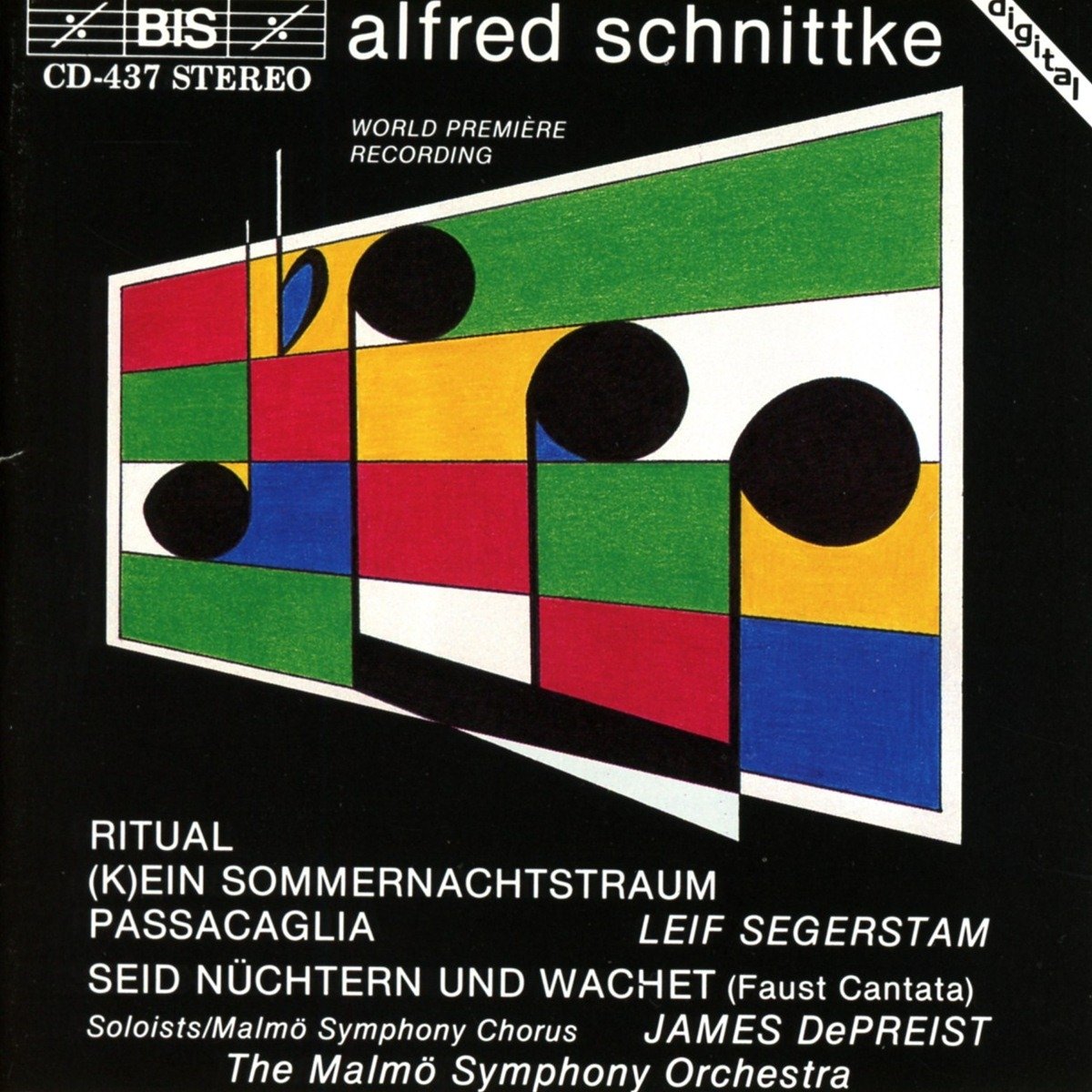
I wish I could say I liked this more given Faust is involved and Schnittke I was really interested in. This was a little too fluid for me or something... idk - didn't jam somehow.
Quote:
Seid Nuchtern und Wachet (Faust Cantata), for soloists, chorus & orchestra
Description by John Keillor
This enormous work requires a large orchestra, chorus, organ, and four solo singers. It is a prequel to an opera and came about when the Vienna Singing Academy requested a work for the 1983 Vienna Festival. For the libretto, Schnittke chose the last chapter of an adaptation of the second book of Faust by Johann Spies. About 35 minutes long, the score does not reflect the more mischievous tendencies of the composer. This may be because his past experiences with Austrian audiences have been filled with controversy, even outward hostility. It is a straightforward, secular cantata, with occasional, unpredictable, and engaging escalations in tension.
The Faust Cantata is made up of ten parts without breaks in between. There are explosive strains of ideas that can leave even prepared audience members breathless. This is especially the case with part seven, "Es geschah," featuring the contra alto and choir. It describes the devil's murder of Faust and the accompaniment is nearly seismic, particularly in the percussion and winds. Even if the work itself frequently morphs from engaging to ponderous, parts are hair-raising, immaculately crafted moments, with the finest instincts for Russian-tinged melody. Some listeners will be enraptured by the entire piece, while others will enjoy it as a body of music with some good sections in it. They are certainly there. Listeners who are beginning to become acquainted with the catalog of Schnittke should wait until his other works have been given sufficient attention. This cantata will otherwise mislead many listeners, because he has written many pieces with a cohesive brilliance and the smiling heart of the benevolent and talented prankster. Those who believe that he can only write music of impish delight must reconcile that opinion to this earnest and often compelling score.
You cannot post new topics in this forum You cannot reply to topics in this forum You cannot edit your posts in this forum You cannot delete your posts in this forum You cannot vote in polls in this forum
 RoundTheBend

 Fischman