BestEverAlbums
Automated account
Profile
- #1
- Posted: 03/07/2026 21:00
- Post subject: Album of the day (#5557): Another Green World by Eno
|
Today's album of the day
Another Green World by Eno (View album | Buy this album)
Year: 1975.
Country: 
Brian Eno discography rank: 1 (out of 51 listed on BEA)
1975 rank: 6
1970s rank: 46
Overall rank: 194
Average rating: 83/100 (from 1052 votes).
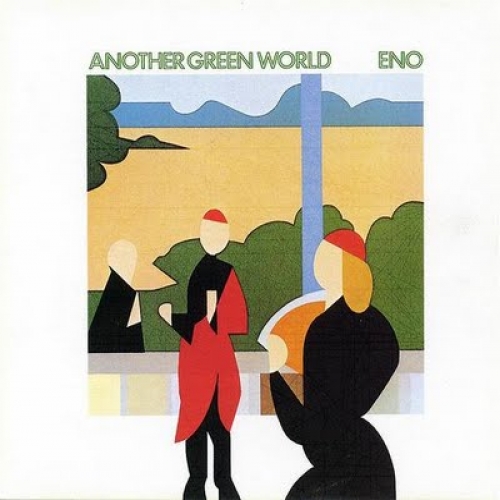
Tracks:
1. Sky Saw
2. Over Fire Island
3. St. Elmo's Fire 
4. In Dark Trees
5. The Big Ship
6. I'll Come Running
7. Another Green World
8. Sombre Reptiles
9. Little Fishes
10. Golden Hours
11. Becalmed
12. Zawinul / Lava
13. Everything Merges With The Night
14. Spirits Drifting
indicates a top-rated track.
Top voted comments:
"I'm still a bit new to this album but it's certainly growing on me. Doesn't sound much like anything else I've heard before, but at the same time it feels like I've known it my whole life. Sounds pretty ahead of it's time, as most great music does. Favourite tracks so far are: 'Sky Saw', 'Over Fire Island', 'Sombre Reptiles', 'Zawinul/Lava' and 'Everything Merges with the Night'."
- JamesCollier (Rating: 90/100)
________________________________________________________
"Perhaps there is no figure who approached music as a science more capably than Suffolk's sagacious Brian Eno. Eno, the preeminent sonic architect, crafts his tiniest compositions with the delicacy of an artisan with his most grandiose and longform exhibitions resembling sprawling city blocks designed for optimal traversing, with each street name and traffic sign strategically plotted and placed. It seems as if any resulting emotional potency is unintentional, or at least, coincidental. Eno never sought out a comfortable groove in which to ride out his over fifty-year career. Instead, he opted to eschew convention and complacency, hell bent on meeting fresh, uncultivated sediment which was ripe for exploration. After opting out of Bryan Ferry's gyrating, glam force majeure, 'Roxy Music', Eno's subsequent musical forays produced far less immediate and less carnal fruits. Often categorized by complexity and an inherent pension for the abstract, his first pair of solo efforts embraced the unconventional, just as Ferry's project had, but now it was on his own terms as he set coordinates for the great beyond. It wouldn't be out of line to declare that nobody quite looked at music the way that Brian Eno did and, by 1975, he had severed the tendrils of his peers and was ready to deliver a idiosyncratic, alien, and career defining artifact.
'Another Green World' commences with 'Sky Saw', a serrated, buzzing entity with a taste for the dissonant. 'Sky Saw' is the first of a line of tracks linked by DNA and could only exist as mysterious fauna native to an entirely different cosmos. The robotic, ory instrumentation employed makes it seem like a fashionable dance track at a futurist discotheque. When Eno's vocals finally penetrate the aluminum atmosphere, it ends up jarring in a way that's welcomed. It's the lone piece of humanity amidst a mosaic of auditory gadgetry and a stark introduction to record's genetic code. Second track, 'Over Fire Island', contains a far more earthy timbre, largely centered on percussion and wet bass. It wouldn't be out of place at a tribal soiree but the whirring coda ends the dream and places you squarely back into a chilly reality. The track briefly embodies a memory of an AI recreation of native music, yet without a discernable, anthropomorphic soul. The most urgent cut on 'Another Green World' has to be fourth track, 'St. Elmo's Fire'. It's catalyzed with uptempo, accelerative energy with Robert Fripp's proggy guitar solo flooding over the dam and washing overtop of the rest of the components. It's a brilliant approach to the art of the earworm and a visionary compromise between the horizon-less limits of Eno's sonic fantasies and the hard line of pop music's rigid boundaries. The album takes a nefarious turn on 'In Dark Trees' with Eno as its lone captain. The sensation of tumbling downward is tactile, as the shallow, unloving electronic drums dutifully chug on, unswaying throughout the track. It's a brief showcase, but by the end of it, you'd swear you were subterranean and devoid of the sun's kiss. Fifth outing, 'The Big Ship', doesn't include a vocal feature from Eno, a trend that carries throughout the majority of the record. In it's place, a tangible sense of scale is meticulously constructed. The track harbors the qualities of an iceberg, with it's peak gloriously basking in warmth the sun, while the base is left to remain untraversed and unable to be properly gauged. Eno's synth work is frothy and luminous, bestowing the honor of "most winsome" onto 'The Big Ship'. However, its aesthetic beauty is perched above the aforementioned impression of scale and labyrinthian real estate held below like oil resting comfortably on top of the sea. The track is gigantic to the ear despite its minimal instrumentation and Eno's excellence creates a cognizance of a world uncharted between the notes.
The most sugary offering on the record is 'I'll Come Running', which bottles a domestic, romantic syrup into a nearly four-minute nocturne, à la The Beatles' 'When I'm Sixty-Four'. The frolicking piano, which strides to and fro, projects a sensation of repetitive bliss and the notion that life's banalities make for gratifying exertion when in service of a special someone. It's strangely human for Eno, or perhaps, deceptively snide. Side one ceases with the title track, a brief , patient transitional that pokes its head out of the clouds just to be quickly shrouded once more. Eno's 'Desert Guitars' parabola as the track comes and goes like a sun shower. Side two, unfurls with a pair of wordless pieces with alternating physiology. 'Sombre Reptiles' is charged with locomotive energy powered by pistons set to world music of the Peruvian variety. Its straight-line fidelity is in stark divergence with follow up tune, 'Little Fishes', which effectively meanders in a way which could easily harmonize within the confines of a sound studio or underneath an electron microscope. Possibly the most apropos moniker on the LP, the track's prepared piano conjures an image of a minnow swimming up and downstream, susceptible to the gentlest of currents. It's clear by this point that Eno is reserving ample space for some of his most three-dimensional soundscapes. Track ten, 'Golden Hours' surely contains helium, as its carefully batted around expertly by Eno and Fripp. It also holds some of the album's finest lyrical pearls as Fripp's guitar solo sews the track shut with thin kevlar. Subsequent track, 'Becalmed' sounds as if Eno has harnessed the full weight of artificial placidity as the track swells and shrinks at the moments most opportune. Impressively, the music remains terrifically pastoral while also sounding akin to a deep-space, cosmic happening. 'Zawinul/Lava' plays like a wise man recounting an ancient prophecy or event responsible for population bottleneck, with more than a hint of dread as fretless bass drops leave the back door open for distant howls propelled by the wind. It's a musing piece that depicts what's coming and what has occurred without a moment's thought for the present. Eno carves out one more slot for a ballad, as to not drift too far into the ether, but even Eno's narratives inject a dose of the illusory. 'Everything Merges with the Night' depicts a love affair, but in which stage we never know. It's as if Eno wrote a treatment for a couple he viewed on a canvas, no doubt one with soft, pastellic edges. Our subject has been "waiting all evening or possibly years" as Eno's piano ensures us that the character is not displeased or even losing patience. Finally, the record concludes with 'Spirits Drifting', which feels evocative of an ending, yet strangely behaves as if it could run parallel to the entire album. The synth work does indeed achieve spectral ambience, but the track functions more effectively as the main mode of transit for the lost souls of Eno's gaseous, nearly imperceptible world of sonic dominion.
When entering the studio for what would become the third record under his stewardship, Brian Eno was without much of a foundation, save for the knowledge that he had begun to tire of the rock's dependent formula that still lingered on his previous two efforts. His lack of sonic provision actually proved to be a strength in the studio as it aided in the construction of a fossil which relished its own formlessness and supernatural ideology. As the sessions commenced, Eno's vision began to take shape, a vision that permeated like a vapor while remaining stoic and shapeshifting with no classification able to weigh down its ascent. 'Another Green World' was indeed the composer's first step into a new paradigm, where music was kinetic and a naturally occurring element with conscious, sonic landscapes capable of forming their own chemical makeup. It marked the beginning of four-decade long pilgrimage to a haven of musical liberation which had long thought to be bestiary. It was a place that married well with Eno's disdain for the shelters of sonic conventionalism and it's a dimension that Eno has yet to bid adieu to.
Standout Tracks:
1. The Big Ship
2. Becalmed
3. St. Elmo's Fire
92"
- DriftingOrpheus (Rating: 90/100)
________________________________________________________
About album of the day: The BestEverAlbums.com album of the day is the album appearing most prominently in member charts in the previous 24 hours. If an album, or artist, has previously been selected within a x day period, the next highest album is picked instead (and so on) to ensure a bit of variety. A full history of album of the day can be viewed here.
_________________
Bluesky · Facebook · Spotify
|
 SpringPeeper
Level 4