Benedict Anton Aufschnaiter - Serenade Della Pace Year: 1778
Cοncerto Armοnicο Budаpest
Rating: 3.75 Stars
This is a very nice classical serenade, but it can easily fall into the trap of becoming a little too staid. A great choice for when you want something fairly straightforward and proper.
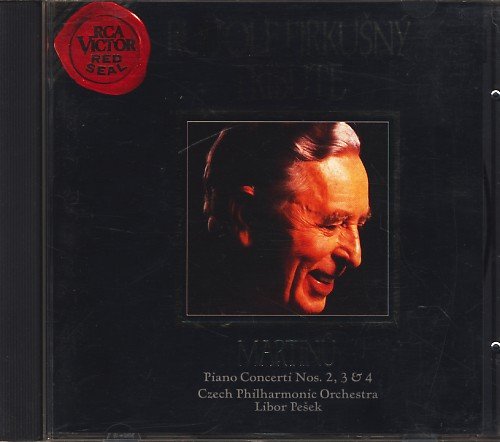
Bohuslav Martinů - Piano Concerto #4, Incantation Year: 1956
Rudolf Firkušný/Piano
Czech Philharmonic Orchestra/Libor Pešek
Rating: 4.5 Stars
This piece is unusual in that it is only two movements, but that's appropriate here. The first movement is full of that patented Martinu tension and his unique harmonic palette. The transition to the start of the second movement is magical; Martinů eases the tension considerably, but somehow still maintains the drama and the mysteriousness actually increases a bit. I listened to a performance by Rudolf Firkušný/piano and the Czech Philharmonic Orchestra/Libor Pešek from a Naxos CD and they do a wonderful job bringing out various subtleties in the score and enhancing the nuances that can easily get lost in a Martinu composition.
As I listened to the first movement, I was struck early on as to how American it sounded which quickly evolved into "this is what an American Martinu would sound like!" and "this could be a cross between Martinu and Piston (great company to be in!). That first movement was fairly short, which is probably just as well since it had such a relentless angular rhyhtmic drive to it. The second movement started off totally beautiful and gradually got darker, but did so without losing its foundational beauty, ultimately taking on a very American film noir soundtrack vibe (not always something that would excite me, but it did here) The final movement was a perfectly balanced bookend to the first movement, and brought everything to a most rousing close! A magnificent work.
As this started, I was thinking "this is pretty." But that initial loveliness quickly evolved into something very Finnish. The specific way the strings make a very northern sounding foundation, and then the way the high brass provides punctuation over that foundation is distinctly Finnish to my ear.
But the beauty remains in place of the more austere vibe that permeates most Finnish music. A lot of Finnish music seems to be informed by the sparce arctic landscape, more specifically the long arctic winter night. But this seems to give us more of the equally long Arctic summer's day. There is light, but not bright light. There is the life brought by the low but constant arctic sun, a sort of gentle but persistent and hardy, understated life. The long second movement really makes this point beautifully. In a rather unusual structure, the grand heroic drama shows up in the third movement, which stirs the blood to a solid climax. That that happens in the third movement seems odd at first until you see that the fourth movement is labeled "Epilogue," and it effectively serves as an extended resolution to the entire piece. Quite brilliant if you ask me.
Okay, so the new to me Schulhoff guy is a smash hit, what a fantastic symphony! That military march that comprises the first movement is just extraordinary in its powerful projection and propulsive force! I cant sa as i generally like marches in my music, but this one ROCKS! At under five minutes, it goes by quick, acting more like an extended introduction than a full fledged opening movement, and that works perfectly for this symphony.
The second movement abandons the march for some more traditional drama, and high drama it is. But its what's ticked away in the corners of the score that really make this movement stand out, like periodic fanfare-like brass calls superimposed on the dramatic foundation, present but not fully in the forefront where you'd normally expect a fanfare to be, lending an air of a heroic common man theme to hreat effect. That is, if youre engaged in active listening; this is not background music!
The third movement brings us a most tempestuous storm, which is executed as a genuine force of nature; man alone can not stand against it... but you never get the sense that he can not survive it. You just have to ride it out... but you realize that while it's gonna be a bumpy ride, it's gonna be a good one and youre gonna emerge stronger than you entered.
Now there was a little unnecessary wandering in the fourth movement, and a theme or motif repeated once or twice too much, but overall thats a very minor quibble, and after scarcely a minute off track, Schulhoff executes a brilliant transition to get us back in the identifiable arc og the musical argument, and we finish strong and solid.
After listening to, and deriving quite exquisite pleasure from this symphony, i did some reading on Schulhoff and I was reminded of the importance of separating the artist from the art. It turns out Schulhoff was a dyed in the wool communist (he died in a concentration camp after having been arrested not for his Jewish heritage, but rather for his being a Soviet sympathizer). Had I known that ahead of time, it might have colored my appreciation.
FischmanRockMonster, JazzMeister, Bluesboy,ClassicalMasterProfile Land of Enchantment
Leoš Janáček - Folk Poetry of Hukvaldy in Songs Year: 1898
Rating: 3.75 Stars
Leoš Janáček - Six Folk Songs Sung bt Eva Gabel Year: 1909
Rating: 3.5 Stars
Thumbnail. Click to enlarge.
I grabbed this disc based on a recommendation to Czech out some písně (písně being Czech for lieder). It was a good suggestion. I expected to like the Janáček, but I'd never heard of Jeremiáš, and his písně were also quite enjoyable. These písně were so good, I even liked the male vocals.
Of the four sets, my favorite was the Silesian Songs. Okay, so maybe I was influenced by my recent trip to Central Europe where I fell in love with the Silesian countryside.
FischmanRockMonster, JazzMeister, Bluesboy,ClassicalMasterProfile Land of Enchantment
John Williams - Concerto for Violin and Orchestra Year: 1978
Detroit Symphony Orchestra/Leonard Slatkin
Emmanuelle Boisvert/violin
Rating: 4.5 Stars
Thumbnail. Click to enlarge.
Here's an astonishingly good concert piece from the ultimate film score composer!
Musically, this may telling a story unlike any I've ever heard before. It opens with the solo instrument a capella, all alone, totally exposed, and apparently trying to offload some existential angst. Another string enters, and the two play together.... well not actually together.... this is where things get really interesting. Its not really a musical conversation such as we might expect so much as teo different entities inhabiting the same space but approaching and experiencing it differently. Two different characters, two different ethos, beautifully coalesced not in their relationship to each other but in their shared environment. It really is quite brilliant.
And then the full orchestra stomps in and promptly drowns out both! No wonder our little violin was so nervous. Eventually, the orchestra relents, and we can hear our solo personality tentatively return but it's clear its not going to be allowed full partnership. The struggle is real.
Here, we have John Williams being incredibly evocative without being at all cinematic.
In the second movement, we have our solo personality tentatively trying to find their way through this challenging world. This is not a great hero pushing their way to conquest, but rather a rather unsure individual poking around here and there, searching for a way out of this unfamiliar musical wilderness. That's the next really amazing thing about this conceto... that we can so clearly get to know this character when they're in such a subordinate role.
David Hurwitz classifies concertos in two categories: virtuoso concerto or justification concerto. The virtuoso concerto is easy to understand: we know all along the soloist is the show, and the orchestras purpose is to set up and support the soloist. The justification concerto is a little harder to understand; here the soloist must earn their way in the piece. They have to do something to establish their credibility; to justify their existence in this musical world. Of course it's not so binary as that; there's a continuum.... and this particular concerto may be the purest example of the justification concerto. In verbal description, it doesn't sound like my favorite approach, but here, Williams delivers a piece that absolutely amazes me.
If the second movement was about our solo personality trying to find their way, the third is about them trying to find their footing. Over those last 10 minutes, our little violin gradually gains gonfidence, ultimately finding their place in this musical landscape and establishing a presence there. Again, this is not a conquest; instead it becomes a sympathetic cohabitation... a consonance of sorts. Despite the lack of any explicit heroic victory, it's surprisingly satisfying.
Even though there's no obvious recurring melody or musical theme as we proceed from movement to movement, the piece feels strongly cyclical with the exceptionally well argued story ark establishing clear links from I to II to III.
You cannot post new topics in this forum You cannot reply to topics in this forum You cannot edit your posts in this forum You cannot delete your posts in this forum You cannot vote in polls in this forum
 Fischman