Claudio Monteverdi — Vespro della Beata Vergine Year: 1610
John Eliot Gardiner - Conducter
The Monteverdi Choir
The English Baroque Soloists
The London Oratory Juniors Choir
Ann Monoyios - Soprano
Marinella Pennicchi
Michael Chance - Counter Tenor
Nigel Robson - Tenor
Mark Tucker - Tenor
Sandro Naglia - Tenor
Bryn Terfel - Bass
Alastair Miles - Bass
Basilica di San Marco, Venice. 1990
Rating: 4.5 Stars
Rinaldo Alessandrini, Concerto Italiano
Rating: 4.25 Stars
Never thought I'd get around to this.
I originally had no interest in vocals in my classoal music
Then came Beethoven's 9th.
But that's it
But then came Novak's Slovak songs.
Okay, now I'm sure that's it.And I surely don't want any slow vocals!
But then came Gorecki's 3rd.
Okay, now I've found my real boundary, and I'm never going to like any church music!
Well, tn in walks J.S Bach, cantatas in hand. Wow!
But hey, that's Bach, eh? No reason to think anyone else can impress me like that.
And there's certainly no reason to travel back another quarter century from that!, right?
Well, actually there is... because this Monteverdi cat can write!
I went into this blind other than trying to pin down the best recording among the many available. The consensus pointed heavily to Gardiner's 1990 reading so that's what I went with.
....and...
Ahhhhh, the glory of the human voice as a musical instrument as opposed to just a deliverer of lyrics! Magnificent! Whether male or female, solo, duo in counterpoint, or full choir... beautiful.... and oh, so.... musical!
And yes, this performance is incredible. From the glory of the dueling tenors in Duo Seraphim, the beautifully combined choirs of the Nisi Dominus, to the fantastic counterpoint between vocalists and instruments (corners in particular) in the Sancta Maria, every last nook and cranny of this monumental work has something fresh to say, and say it it does in a most beautiful way.
That Monteverdi could write something so expansive, with such going on at times, and still keep individual lines distinct, is incredible. That an ensemble can keep that clarity while being so overwhelmingly grand even more so.
So while this was my first and only Monteverdi Vrspers so far, I was quite confident I had indeed selected the best version. No need to go seeking any other.
But after listening mostly blind, I did a little more research and learned Monteverdi left a lot of room for interpretation and different conductors take good advantage of this freedom. So I just had to grab another. Luckily, I managed to grab a less grand, more personal version which provided good contrast. Rinaldo Alessandrini and Concerto Italiano give us a more intimate reading that seems no less valid. I'll probably always gravitate a little more often to the Gardiner, but I can certainly see there being times where my mood might dictate I grab the Alessandrini.
So almost 4 hours of vocal church music for a guy who thought he didn't like it, and found himself loving every minute of it... not bad, eh?
Franz Joseph Haydn - String Quartet, Op. 50, #3 Year: 1787
Tokyo Quartet
Rating: 4.25 Stars
Franz Joseph Haydn - String Quartet, Op. 50, #2 Year: 1787
Tokyo Quartet
Rating: 4.25 Stars
Franz Joseph Haydn - String Quartet, Op. 50, #1 Year: 1787
Tokyo Quartet
Rating: 4.5 Stars
I ended up listening to the first half of the Haydn Op. 50 set in reverse order. This was due to the #3 coming to me as a recommendation and, as expected, I loved it, so I had to check out the first two. They managed to be even better to my ear! (which is in no way a slight against the third; it truly is wonderful.
As in checking out an either new-to-me or less familiar Haydn Symphony, I love doing the same with has quartets. As many of them as there are, I know I'm always going to hear something unique or innovative, some way in which Haydn is combining things differently or moving the art forward.
What I got in the third kicked off right in the first movement. There was an unusually strong voice in the viola, the oft forgotten stepchild of the string world. The second movement seemed to be pretty rote to start off with, but halfway through the movement, it went through a dramatic transformation that really shook things up, in a very good way. The third movement did much the same and I was just loving all the unexpected twists and turns that always engaged but never disrupted. The final movement Is one of Haydn's more rousing closers, but I thought it came to a rather abrupt close (not quite Monty Python and the Holy Grail abrupt, but still not offering the full resolution I'm used to with Haydn.... maybe this was another "surprise"). But my fascination with his employment with the viola ran pretty much throughout. Haydn has the viola often doubling the 2nd violin, then branching off and running an inverse line
Stepping back to the second quartet in the set, I found it to be at least the equal of the first, maybe even a tiny notch above. It was a little more serious/dramatic, and it definitely had more of what I would call "punctuation." How much of that was the composer's intent and how much of it was a stylistic choice by the Tokyo Quartet, I don't really know, but I do know it worked. And again, Haydn pulled off those dramatic transitions midway through the middle movements.
After all that, I had no reason to think I'd be digging the first quartet even more.... but I did. The first movement was particularly amiable, even by Haydn standards, which is really saying something. It was like a warm greeting from an old friend. The second movement was just incredible, introducing some serious gypsy music we don't normally associate with Haydn, and it was way cool! The third movement was impressive, and most welcome, as it's the first time in the set I heard the cello really get to be the anchor, centering the piece. . In the final movement, Haydn goes hog wild with syncopation and damn is it lively! Yeah, it rocked.
FischmanRockMonster, JazzMeister, Bluesboy,ClassicalMasterProfile Land of Enchantment
Johann Baptist Vanhal - String Quartet in G Major, Op. 6, no. 1 Year: 1780
Kubin Quartet
Rating: 4 Stars
The same recommendation that brought me Haydn's quartet 50/3 also brought me this one. Seeing how brief this was, I was happy to give it a go even though I'd just completed over an hour of Haydn quartets. Vanhal was a contemporary of Haydn's, this quartet being written seven years to Haydn's Op. 50.
So, as I launched into this thing, the first thing I noticed was that this is, as if it was even possible at this point, even more amiable than the first movement in Haydn's Op. 50 #1. Again, like being greeted warmly by an old friend, but maybe a slightly more casual, less deep friendship. The second movement was then a slight shock, but in the best possible way, as it brought some real mystery into the equation, as if to say "okay, so this friend has changed since I last saw him.... how do I now approach this relationship?" The third movement was fine, nothing earth shattering, but served as an adequate closer (this quartet has but three movements). I won't fault it because really, the first two movements raised the bar so high, I can't imagine anyone having a closer fully up to the task. Sill, a very satisfying overall listen, and with less than 12 minutes total investment, it was good pleasure bang for your time buck.
Franz Joseph Haydn - String Quartet, Op. 54, #2 Year: 1787
London Quartet
Rating: 4.75 Stars
Thumbnail. Click to enlarge.
After thoroughly enjoying the first three of Haydn's op. 50 quartets, I was reading up on them via various sources and stumbled upon a proclamation by David Hurwitz (a critic with whom I share much taste in common) that Haydn's Op. 54, #2 is his "most extraordinary quartet." Now that's a bold claim. Now Mr. Hurwitz, have you heard Op. 76 or Op. 77? Really... think about what you're saying!
But such a claim from such a reputable source demands investigation, so I decided to make fresh run at this extraordinary quartet. So what did I encounter?
Well. To kick things off. The first movement may have Haydn's most effective counterpoint, which itself is no small claim now on my part. But I was amazed and for now, I'm standing by that claim.
The four parts start off the second movement like a sort of four part chorale for strings, and it's beautiful, as well as an effect I never expected to hear in a classical quartet.
The third movement starts off slow, builds drama. And as it proceeds to a menuetto allegretto, the London Quartet makes extremely effective use of accelerandos and retards, allowing tempo to make this a nonstandard and continually interesting dance movement.
But even after all that, the biggest surprises come in the final movement, marked adagio/presto/adagio. Now by this time, we've gotten used to Haydn opening a fast movement with a slow introduction in a Symphony... but in a quartet? And always in the first movement, but the fourth? And then the biggest surprise is het to come. That opening adagio isn't just a brief introduction; the presto doesn't appear until we're 4 1/2 minutes into a movement that's all of 6 1/2 minutes long. And there's another adagio coming to close the piece (another nonstandard element), so that presto goes by really fast. So out of an entire traditionally fast movement, we get all of about a minute of presto..... and it works brilliantly! Really, it's as satisfying a final movement as I've heard.
So in the end, I can understand Hurwitz's claim. It is indeed a massively extraordinary quartet. Haydn's "most extraordinary?" Possibly. It may not displace my favorite (that would be Op. 76, #4), but I do love it through and through, and not only that, I have a level of respect for it commensurate with my emotional appreciation for it.
Wolfgang Amadeus Mozart - String (viola) Quintet in G Minor Year: 1787
Alban Berg Quartet
Rating: 4.25 Stars
Thumbnail. Click to enlarge.
Wolfgang Amadeus Mozart - String (viola) Quintet in G Minor Year: 1787
Talich Quartet
Rating: 4 Stars
I was in the mood for a Mozart quintet, and landed on this surprisingly tragic work, coincidentally from the same year as the great Haydn quartet I just listened to . I'm always interested in the selection of additional instrument for a string quintet, viola or cello, and how is that to be employed. Each brings a very different additional voice and requires significantly different execution to achieve the right balance. But hey, this is Mozart we're talking about here.... we could hand him a trombone, glockenspiel, two kettle drums and a kazoo and he'd bring back something that is the epitome of classical balance.
But I wasn't so sure in the first movement. That second viola spends a lot of time mirroring the first viola and the second violin to the point that it seemed rather redundant, especially since the three of them spent most of their time providing an ostinato for the first violin to ride upon, and the cello, already outnumbered at this point, seemed underused. But there was no denying the beauty of that violin line, and the trio of middle strings were instrumental in creating the tragic atmosphere, so still a good listen.
The minuet comes second in this piece, but it's hardly a dance movement at this point. The dark mood remains, and there's plenty of tempo changes, so I can't imagine actually dancing to it, with or without powdered wig. But that's okay as its a powerful, moving piece, and Mozart ends up being quite brilliant in how he takes what is traditionally the lightest part of a work and makes it extra deep.
Although in a major key (Eb), the third movement plumbs the depths even further. Slow and wistful, it also includes long stretches of syncopated eighth notes.... look, it's classical reggae! Not really a recommendation in my book, but of course Mozart carries it off in wondrous fashion. None other than Tchaikovsky said of this movement, "No one has ever known as well how to interpret so exquisitely in music the sense of resigned and inconsolable sorrow."
The final movement kicks off with an absolute dirge, still slower and darker than all the movements preceding it before launching into a much brighter allegro that resolves things much as you might come to expect from Mozart. However, while many experts play up the contrast, as if everything has turned into rainbows and unicorns, I actually hear it a little differently. To my ear, the darkness has not fully dissipated, but rather; it still exists, but the theme seems to be that we have learned to coexist with it, and that understanding is what brings the relative lightness we're now enjoying.
I gave this two listens, first by the Alban Berg Quartet and then by the Talich Quartet. The first is astonishingly crisp and precise with the latter being more emotive. Being that this is a relatively dark and heavily emotive piece, I would expect the Talich to be the better approach, but ironically it seemed the crispness of the Berg brought out the message with greater clarity. Both solid performances to be sure, but I can really see myself reaching for the Berg first in most cases.
FischmanRockMonster, JazzMeister, Bluesboy,ClassicalMasterProfile Land of Enchantment
Vitezslav Novak - South Bohemian Suite Year: 1936-1937
Brno State Philharmonic Orchestra/Jaroslav Vogel
Rating: 4 Stars
I have loved everything I've heard from this composer and, with my inner Czechophile coming to the surface today, I decided to give his South Bohemian Suite a run.
Another perfect choice!
This unique, four movement suite takes me right back to the old country. The first movement, "Pastoral Horizons," is aptly named. My first thought was this wouldn't be out of place setting the stage in Janacek's The Cunning Little Vixen. This is not to say that Novak sounds like Janacek, but rather that it sounds like both of these pieces feel like they come from the same place, which is a testament to both composers' connection to their rural countryside. In both cases, they help me feel that connection and it's beautiful. The second movement, "Reverie: Forests and Ponds, isn't quite so aptly named; "reverie" to me implies something pretty lively, and this is a slow movement throughout, but with an occasional breeze in the forest or bubble in the pond. Slow or not, the beauty actually exceeds that of the first movement, as if the first movement was really setting the stage for this, and this capitalizes on that foundation. The third movement, "Once Upon a Time: March of the Hussites," is a great listen independent of program, but probably wouldn't have reached me at the same level had I not recently traveled to Czechia and learned a good deal of Hussite history. There is a march here, but not a pure one; more just enough of one to have character matching the program while sitting next to all that pastoral beauty. There is a very short 4th movement, "Epilogue: I Greet You, My Homeland!," that rounds out the suite as a genuine ode to a beloved place
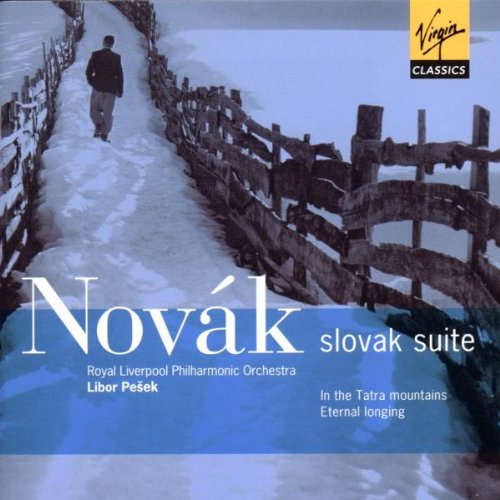
Vitezslav Novak - Slovak Suite Year: 1903
Royal Liverpool Philharmonic Orchestra/Libor Pesek
Rating: 4.5 Stars
One good suite deserves another, eh? So I grabbed Novak's earlier Slovak Slovak Suite, inspired by his visit to Moravia where he encountered and developed a love for Moravian/Slovakian folk song. Like the South Bohemian Suite, I checked into this listen without researching anything ahead of time. Immediately in the first movement, I got a strong chorale vibe, so even without overt church references, it seemed to me to be inspired by church music. The later appearance of an organ seemed to confirm this. Upon studying the piece afterward, I learned the first movement is titled "At Church." I could claim to have a discerning, ear, but instead, I'll give credit to the composer for being effective in delivering his program. Oh, and this movement is, if anything, even more beautiful than anything in the later South Bohemian Suite! The second movement brings the fun, but in a remarkably sweet and gentle way. It is entitled "Among the Children," maybe not something I would have guessed with precision, but it certainly fits! The third movement, "Two in Love" begins with all the lush romanticism you'd expect from such a title, but A minute and a half in, we get an unexpected shift to something more likey, which gives way to the original more peaceful vibe before combining the two thoughts into a coherent synthesis, which I take to represent the quiet and the more exuberant phases of a loving relationship. Now unlike the South Bohemian Suite, the Slovak Suite gives us five movements, the fourth being "The Band." This is where the Moravian folk song flavor is most evident, and it's a joy to listen to, with these exuberant tunes given a thoroughly romantic treatment. So what do you do after you party? If you're like most of us, you need a rest. The final movement is "At Night." At almost 12 munites (contrast that with less than 2 minutes for the final movement of the South Bohemian Suite), one would think it would throw off the balance of the piece, finishing with such a long, slow movement. But not so! First of all, Novak maximizes the beauty quotient again, with harp and flute gently floating atop lush and soothing strings in the most gorgeous of lullabies. How odd that, after 12 minutes of gentle serenade, I feel like raising both hands as if to signal "Touchdown!" and shout "Bravo! Bravo!"
I recall making a run at both Pines and Fountains about 35 years ago. After going absolutely bonkers over Respighi's Ancient Airs and Dances, I just randomly grabbed whatever seemed to be most popular Respighi at the classical music store. I didn't really take to it. In retrospect, I think that was because I had my heart set on another Ancient Airs and Dances and these were something entirely different in every way; inspiration, era, orchestration, construction. Even as a neophyte, there was no missing Respighi's mastery of orchestration, but that wasn't really what I was looking for. Now with much broader experience and musical understanding, I thought it might be a good time to make another run at The Pines, especially as that was the sort of the thing I was in the mood for. And yes, I loved it. The exuberant opening movement seemed like it might be more worthy of being one of the Roman Festival than the Pines, but it was certainly fun, and the contrast made the mysterious pines of the second movement even more powerful. After the fun and the mystery, the third movement brings us serenely compelling nocturnal beauty.... and live birds! Finally, the closer brings us a massive climax that seems it could blow us right out of the concert hall! Yeah, there is much to love here, rather shocking that I didn't immediately take to it early in my Classical journey as Respighi is oft cited as gateway classical and this is one of his most beloved pieces. It's amazing what very specific expectations can do. Fritz Reiner's reading with the Chicago Symphony Orchestra is generally considered the gold standard for this piece and I can see why; Reiner deploys his orchestral forces brilliantly, emphasizing exactly the right level of emphasis from each and every instrument at exactly the right time, so important in maximizing the effect of a piece so dependent on orchestral colors to make its point.
Well, having enjoyed the Pines so much, I figured why not go ahead and take on the whole Roman Trilogy, Although Reiner is again the obvious choice for the Fountains of Rome, I wanted to listen to another interpretation and ended up with Toscanini, who it turns out was a contemporary/good friend of the composer and who was intimately familiar with the piece. That familiarity shows in his reading with the NBC Symphony Orchestra. Toscanini really gets inside the piece and every bar of this music seems to grow organically from the origin of its composer's musical mind. The cool thing about the program for these for impressions of Roman fountains is that they proceed through the day, the first fountain visited at dawn, the next in the morning, one at noon, and one at sunset... and yes at each juncture, Respighi's score (and Toscanini's interpretation) bring out the time of day as well as the impression of the fountain itself. Of particular interest is that the world famous Trevi Fountain is the one visited at noon, and the music gets a little loud and even pushy, as various parts of the orchestra seem to be trying to push each other out of the way; it's almost as if Respighi could foresee the coming hordes of tourists jockeying for position in the midday sun to get a glimpse of the famous landmark!
Enjoying trying out a different conductor for each, I grabbed Loren Maazel's recording of the Roman Festivals with the Pittsburgh Symphony Orchestra. The Roman Festivals begin with a real wake up call from the brass announcing the Roman circuses, bringing pageantry of the spectacle to full musical display. Interestingly, the second movement is calm (not unexpected for a second movement after so rousing a first), but it's called "Jubilee," a word that, at least to me, announces something more lively. But it's pretty and serves as a good palette cleanser between the boisterous opener and the coming "Harvests of October," a magnificent blend of pastoralism and excitement. Once more, in this suite, Respighi brings everything to a massively rousing close. The performance and recording were quite good here, even if not as renowned as some other recordings.
FischmanRockMonster, JazzMeister, Bluesboy,ClassicalMasterProfile Land of Enchantment
Richard Strauss - Oboe Concerto in D Major Year: 1945
Swedish Radio Symphony Orchestra /Daniel Harding
François Leleux/Oboe
Rating: 4 Stars
Thumbnail. Click to enlarge.
I was in the mood for some oboe, maybe a little on the buoyant side, and settled on this canonical work by Richard Strauss..... and holy relentlessly light and lively melodies, Batman! It took me less than a dozen bars to figure out why this is so beloved a piece. I can't say I was always a fan of Strauss's grand orchestral, over the top statements. I put this on and it was paint me pink and call me a flamingo! This piece is scored for small orchestra, allowing the oboe to really shine without having to fight for its place on the stage. As delightful as the firs7 movement melodies are, the second movement melodies are equally lovely. In the third movement, the buoyancy of the lead instrument reaches its peak and the oboe and small orchestra dance together in a gloriously refreshing partnership. What a sweet piece.... and oboist François Leleux brings out all the expressiveness available in both the score and his instrument.
Ruth Gipps - Oboe Concerto Year: 1941
BBC Philharmonic conducted/Rumon Gamba
Juliana Koch/Oboe
Rating: 4.5 Stars
After the Strauss, I decided that, as much as I enjoyed it, I was still in the mood for some more oboe, but maybe something a little less buoyant; something a little moodier where the oboe reaches a little deeper into its lower register a little more often, and maybe even does a little brooding. So I took a suggestion for this piece by Ruth Gipps, a composer I don't recall having ever heard.... aaaaaand....... holy stupendous suggestions, Batman! I fell right in love with this piece. Not quite as low and moody as I was hoping for, it nevertheless hit both my general everyday elements of appreciation and my current temporary mood right on target, dead center. I must surmise that, being an oboist herself, Gipps was especially well poised to maximize everything the oboe has to offer in a concerto. But in addition to the marvelous melodies spanning the instruments full expressive range, she has composed fantastic accompaniment and the way the solo instrument and orchestra circle around each other, sizing each other up, almost like a mating dance, is positively brilliant. While they ultimately arrive at the same place, it's clearly the solo character that is in charge as things come to a close, and in the context of this particular piece of music, that's a most wonderful thing.
I love discovering a new composer and really enjoying that introductory work such that it inspires me to seek out more of their ouevre, but with Gipps, I'm a little concerned about potentially seeking out more. This was so absolutely dead on perfect to my ear and my taste, that I fear it can only go downhill from here! Add to that her experience with the oboe and its obvious contribution to the magnificence of this piece, and I doubt she could write anything in any other format which could compare.
Franz Joseph Haydn - Symphony #88 Year: 1787
Austro Hungarian Haydn Orchestra/Adam Fischer
Rating: 4.5 Stars
Autumn has arrived, which means its stuffed squash for dinner time. So I needed some music to stuff squash by. I decided Haydn's 88th should fit the bill. If I recall correctly, Haydn's 88th was the first Haydn I ever heard, and I instantly fell in love with it and thus I launched my now decades long love for Papa Joe's music. I grabbed Adam Fischer's recording, which could have gone either way. I love how Fischer treats early Haydn, but I feel he loses some of the weight of Haydn's more mature symphonies. With in the first few bars though, Fischer said relax, I got this; yes his treatment of ol' number 88 is dandy. Hit the spot just right. The balance of harmonies in the first movement was totally on point. I'd forgotten how dramatic the second movement can get and surprisingly, Fischer hits it full force yielding full impact. Perfect. The only disappointment came in the minuet, where his overly staccato style robbed the stately dance of some needed flow. But all was forgiven in the final movement, where we finish with the epitome of classical balance and style.
Ruth Gipps - Symphony #1
Year: 1942
BBC Philharmonic/Rumon Gamba
Rating: 4.25 Stars
While the squash was baking, I wanted something else to listen to, and having loved the Gipps Oboe Concerto, I decided to make a run at one of her symphonies. Fearing she wouldn't write a symphony as well as she wrote for her native oboe, my fears were quickly dispelled. Another magnificent piece. Her facility with gripping melody isn't dimished one iota! The first movement in particular is full of great melodic lines, sometimes reminiscent of Howard Hanson, which for me is very strong praise! Another strong winner!
Johann Christoph Altnikol - Frohlocket und jauchzet in prächtigen Chören Year: 175?
Rhеinischе Kantorei; Das Klеinе Konzert; Hermаnn Mаx
Barbаra Schlіck (soprano); Hеіn Mееns (tenor); Hаrry van der Kаmp (bass);
Rating: 4 Stars
Had a great little vocal/choral discovery this morning. As I listened to this delightful bit of high baroque sacred music, I couldn't help but wonder what Altnikol's father in law, Johann Sebastian Bach, would have thought of it. This is well crafter baroque church music to be sure, and the interplay between the instruments and vocals is good enough to make the old master proud. Now it doesn't have that touched-be-the-divine level of sublime perfection i associate with the elder Bach, but you know what it is?
It's fun.
Church music isn't supposed to be fun, but this, at least for me, definitely crosses a fun threshold... and it does so without pandering, becoming lightweight, or losing its sacred identity.
Marvelous.
Who says we shouldn't be able to kick up our heels a little in the pews?
You cannot post new topics in this forum You cannot reply to topics in this forum You cannot edit your posts in this forum You cannot delete your posts in this forum You cannot vote in polls in this forum
 Fischman