It sounds like what this thread is suggesting is that, as we assign ratings to albums, we're to match our aesthetic averages (the ratings we associate with terms like 'fine' or 'decent') to the arithmetic median. But this is an odd suggestion, isn't it? Why should the fact that 50 is equidistant from 0 and 100 have any bearing on what I take to be an average album rating?
I'm not saying that we don't have responsibilities when it comes to rating albums. But those responsibilities are entirely aesthetic, right? Good albums get good ratings, bad albums get bad ratings, that kind of thing. It's not as though we have obligations to respect an arithmetic mean, or median, or whatever it is. That would be bizarre.
I suspect a category mistake has been made here. Maybe what's happening is that 'average' is being equivocated with 'arithmetic median'? It's true that in certain contexts these words will mean much the same thing, but in most contexts this isn't the case (average height is not exactly half the height of the world's tallest person, for instance).
Quote:
if the amount of people under average and higher than average is equal, then there's something wrong
This will depend on how we define 'average'. If by 'average' we mean 'median', then by definition there will be as many people over the average as there are under the average.
There is this issue, and I'm certain it stems from a variety of factors. Like crowd sourcing --- whatever is popular, for example, will be what has the most data points. Whatever is "highly-acclaimed" by critics and the general public will have the highest ratings.
To limit it down to specific factors like these for each album would be quite time-consuming, and would involve the collection of a lot of data ---
1) scraping all of the ratings and time of ratings of all the members for all the albums;
2) tracing the nodes of posts, ratings, and reviews of albums on other sites chronologically back in time to the root node to understand how and when specific albums became popular or acclaimed (bayesian networking and bayesian statistics, etc);
3) comparing the timings of 1) and 2) and how 1) is influenced by 2) (and vice-versa);
4) being able to identify inconsistencies like outliers that rate an album particularly poorly (like a 5) based purely on the instinct to sabotage the album's average rating;
--- and a lot of analysis or interpretation of that data, most likely exploiting principles of Least-squares regression analysis, probability, and game theory (decision science in how people make a decision, like how they make a decision on how good an album is). Also, analyzing this data could theoretically lead to some predictive power on how people will tend to rate the album in the future.
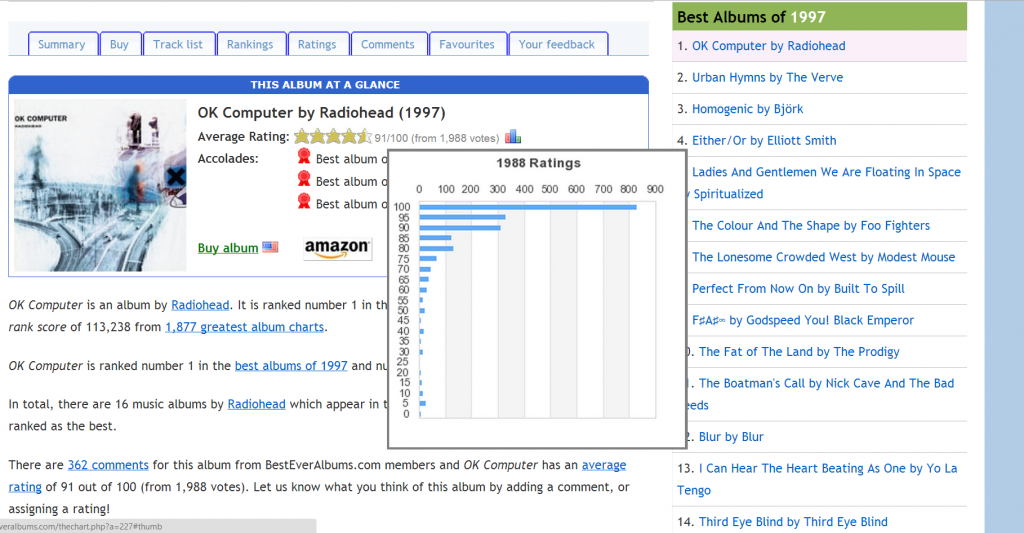
In reality, the collection of a lot of random data on a scale of 5 - 100 should yield a more normal distribution as we collect more data points. This is the tenant of the Central Limit Theorem. So, for example, OK Computer, one of the most-rated albums on this site, should have one of the most shapely Gaussian binomial distributions of all. And, considering this album is highly acclaimed, the mean should be shifted to the right and have a rather small variance (small standard deviation). The result is actually only a representation of half of the binomial model because the mean's been shifted out so far to the high end of the rating scale that it would seem if people could rate it higher than a "100", some people would. Almost half of the samples are 100. Because most people have rated it highly, people believe that they're expected to rate it highly as well, so they do. Some biased independent thinkers, in turn, dissidently rate the album a "5", as low as possible, to influence the rating.
Thumbnail. Click to enlarge.
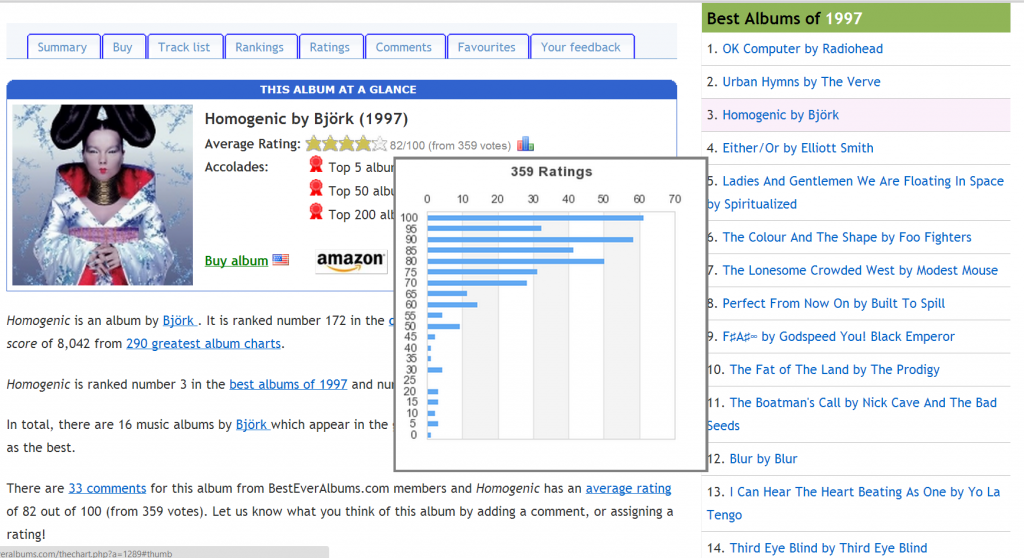
Just take a look at Bjork's Homogenic, for example. I just looked at it, and the distribution doesn't look binomial at all. It's obviously not influenced by a simple random sample; otherwise, there would not be that rather large peak in ratings at "100". It's been influenced by the bias of a crowd of steadfast Bjork fans that necessarily feel it's a duty to rate the album "100" or simply believe that it is that good, compromising the integrity of what could be a random sample yielding normal distribution. Not to say this is something wrong to do.
Thumbnail. Click to enlarge.
I'm going to develop models of some albums by peering into the history of them, and I'll share results and analysis later. This interests me! And maybe I can also make some predictions as well. _________________ <--suddenly...Bora!
#BodyRollSwag
Is it alright to rate music at all? I was thinking last week that the albums are peoples hopes and dreams. Then people come along and tell them if they were worth it. Or perhaps if they themselves are worth it. 🤔 Otherwise maybe 100's all round would be great.
meccaleccaVoice of ReasonProfile The Land of Enchantment
Ratings don't really mean a thing. i don't feel like reading the 5 pages of the thread so far but the thing I think the OP is missing is that people generally rate what they love or hate. Mediocrity is a very very tough thing to rate, because you have such undefined feelings around it.
i don't feel like reading the 5 pages of the thread so far
That's why you completely skip the SilverWalrus vs antihero36 thing lol
Quote:
but the thing I think the OP is missing is that people generally rate what they love or hate. Mediocrity is a very very tough thing to rate, because you have such undefined feelings around it.
good point. people's passions are always huge influences on their decision-making processes. people probably base their rating on 1) reason; 2) passion; and 3) cognition. a combination of these things. which is alright, whatever. but also based on 4) pre-defined influences. Like whatever has already been ranked really highly or really lowly, they'll rank similarly.
another issue, I think, is an inherent problem with the Bayesian algorithm used to determine the mean. I know it's supposed to limit the effects of outliers, but it seems to keep the averages of badly-received albums too high and keeps the average of well-received albums down, so then people feel more inclined to keep giving it perfect scores so that that average will hopefully increase (but it doesn't, because the Bayesian algorithm decreases how much any given sample affects the average). I want to look more into algorithms commonly used. _________________ <--suddenly...Bora!
#BodyRollSwag
You cannot post new topics in this forum You cannot reply to topics in this forum You cannot edit your posts in this forum You cannot delete your posts in this forum You cannot vote in polls in this forum

 soundguardian

 <--suddenly...Bora!
 meccalecca