John Wesley Harding
by Bob Dylan
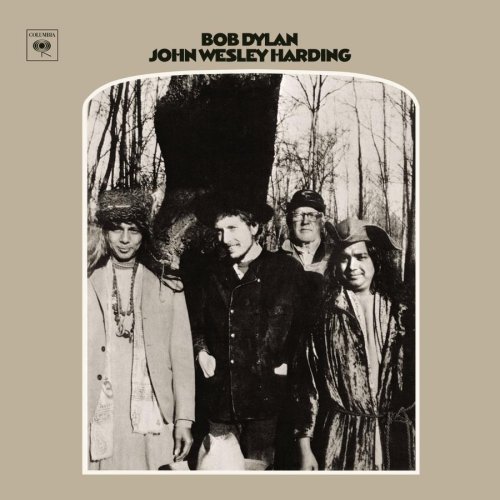

Listen & Collect
Complete your collection or upgrade your listening experience.
Bob Dylan bestography
John Wesley Harding is ranked 9th best out of 81 albums by Bob Dylan on BestEverAlbums.com.
The best album by Bob Dylan is Highway 61 Revisited which is ranked number 29 in the list of all-time albums with a total rank score of 25,105.
(N.B. Bestographies include all albums by an artist (and their variations), but do not include albums ranked outside the top 100,000).
Listen to John Wesley Harding on YouTube
John Wesley Harding track list
The tracks on this album have an average rating of 82 out of 100 (all tracks have been rated).
Top-rated track as rated by BestEverAlbums.com members.
John Wesley Harding rankings
Calculated from aggregate positions across 60,000 charts (2 million album rankings). Click to see how the rankings are calculated (Last updated: 7 hours ago)
| Year | Source | Chart | Rank | Rank Score |
|---|---|---|---|---|
| 2026 |  NowhereMan NowhereMan | Top 34 Music Albums of 1967 | 9/34 | 4 |
| 2026 | lanadeleswift | Top 58 Music Albums of 1967 | 12/58 | 4 |
| 2026 |  baystateoftheart baystateoftheart | Top 80 Music Albums of 1967 | 66/80 | 1 |
| 2026 | Johnnyo | Top 100 Music Albums of the 1960s | 94/100 | 1 |
| 2026 | NowhereMan | Bob Dylan - RANKED | 12/19 | - |
| 2026 | martintho | Top 60 Music Albums of 1967 | 15/60 | 4 |
| 2026 |  Brandon8 Brandon8 | Bob Dylan Top 15 Albums | 9/15 | - |
| 2026 |  RockyRaccoon RockyRaccoon | Top 100 Music Albums of 1967 | 59/100 | 2 |
| 2026 |  Taka Taka | Top 97 Music Albums of the 1960s | 41/97 | 12 |
| 2026 | jonny5244 | Top 33 Music Albums of 1967 | 26/33 | 1 |
| Total Charts: The total number of charts that this album has appeared in. | 485 | |||
| Total Rank Score: The total rank score. | 2,036 | |||
John Wesley Harding collection
Showing latest 20 members who have this album in their collection | Show all 397 members


John Wesley Harding ratings
Average Rating = (n ÷ (n + m)) × av + (m ÷ (n + m)) × AVwhere:
av = trimmed mean average rating an item has currently received.
n = number of ratings an item has currently received.
m = minimum number of ratings required for an item to appear in a 'top-rated' chart (currently 10).
AV = the site mean average rating.
Showing latest 3 ratings for this album. | Show all 783 ratings for this album.
| Rating | Date updated | Member | Album ratings | Avg. album rating |
|---|---|---|---|---|
| ! | 2 hours ago | pharoahstune | 223 | 81/100 |
| ! | 09/29/2026 10:20 | Siromynian | 1,773 | 74/100 |
| ! | 09/24/2026 17:59 |  covecove covecove | 6,719 | 74/100 |
Rating metrics:
Outliers can be removed when calculating a mean average to dampen the effects of ratings outside the normal distribution. This figure is provided as the trimmed mean. A high standard deviation can be legitimate, but can sometimes indicate 'gaming' is occurring. Consider a simplified example* of an item receiving ratings of 100, 50, & 0. The mean average rating would be 50. However, ratings of 55, 50 & 45 could also result in the same average. The second average might be more trusted because there is more consensus around a particular rating (a lower deviation).
(*In practice, some albums can have several thousand ratings)
This album is rated in the top 2% of all albums on BestEverAlbums.com. This album has a Bayesian average rating of 78.1/100, a mean average of 77.1/100, and a trimmed mean (excluding outliers) of 78.1/100. The standard deviation for this album is 14.6.
John Wesley Harding favourites
Showing latest 10 members who have added this album as a favourite | Show all 100 members


John Wesley Harding forum mentions
 BestEverAlbums 09/21/2026 08:00 in Chart of the day (#5442): By martintho BestEverAlbums 08/01/2025 16:03 in Monthly overall chart movements - July 2025
 Purplepash 04/12/2025 08:03 in What album are you listening to? (cont.)
John Wesley Harding comments
Top Comments First | Newest First | Positive Sentiment First | Longest Comments First
(Showing comments with any number of votes. Manage Profile)
 Skinny TOP 100 COMMENTER 10/06/2014 13:09 | #123504 | TOP COMMENT
Vote up your preferred comments and the comments with the most votes will be flagged.
Skinny TOP 100 COMMENTER 10/06/2014 13:09 | #123504 | TOP COMMENT
Vote up your preferred comments and the comments with the most votes will be flagged.
It's funny that most of the comments here allude to this being below par for Bob, and not on the same level as some of his other recordings. Personally I think that's absolute hogwash - this is Dylan at his very best; Dylan the mythologiser, Dylan the storyteller, Dylan the philosopher.
Beginning with the opener and title track, Dylan weaves a series of telling tales about his life and his career as told through the point of view of others. The title track is no more about John Wesley Hardin than it is about Dylan the protest-singer, or at least the one which the media chose to portray. It may seem like a simple tale of a Robin Hood-esque noble outlaw, but the song itself acts as a metaphor for Dylan's own exploits, or at least some exaggerated version of them as dreamed up by those raving, quasi-religious "followers" he was so reluctant to acknowledge in the first place. In the final verse he appears to switch to something more accurate, at least in terms of his opinion of himself and the way he could confound expectations and hopes others had of him ("no charge held against him could they prove"). And why, of all people, choose John Wesley Hardin anyway? The man was apparently so mean that he once killed a man for snoring (though this probably didn't actually happen), so why choose his name for a tale about a noble outlaw? My opinion is that Dylan chose Hardin for his reputation as a self-mythologiser, a man who would wilfully embellish his stories in order to make them more exciting, just as Dylan has been wont to do. (Anybody who seriously believes Chronicles to be a work of accurate autobiography needs their head checked.) Dylan even looks like a noble outlaw on the cover, enhancing the idea that he sees himself as Hardin, or at least the Harding of this song and this album. What people often dismiss as a series of cute folk tales and ditties, ones which I've been told pale in comparison to his apparently more focused and passionate paeans to love or justice, are arguably his most personal (or, perhaps more accurately, his most self-referencing) works, those in which he puts himself smack bang in the middle of the story, even as somebody else entirely.
And we see this happen throughout the record. Dylan is the lonesome hobo who has served his time for everything except begging on the street (or is he? Would he really admit to not trusting his brother?), who in turn is the accused drifter. He is both the joker (whose wine is drunk by businessmen and whose earth is dug by ploughmen, without gratitude or recognition of his worth) and the thief (who understands that life is but a joke). Whilst he is defiant in the face of accusations (he is no martyr), he feels the pressure of expectation, the guilt that perhaps he played along and performed his role, even going so far as to bowing his head and crying in the (imagined) presence of St. Augustine (who wasn't, in fact, martyred - perhaps more mythologising on Dylan's part).
Perhaps the album's two most striking moments, the parable 'The Ballad of Frankie Lee and Judas Priest' and the piano-driven 'Dear Landlord', appear to be about Dylan's relationship with his management. Judas Priest tries to force Frankie to accept his offer "before (it) all disappears"; Frankie, in his attempts to join Judas in his beautiful home, dies of thirst. Did Dylan sell his soul? Is that what he's admitting to? Or is it just a precursory warning about the trappings of fame, about mistaking paradise for that home across the road? But later, on 'Dear Landlord' (frequently thought to refer to God, but that reading doesn't wash with me, it seems far too confrontational for that), he warns that he's "not about to move to no other place". Perhaps he likes the home after all. "If you don't underestimate me", he states to the Landlord, "I won't underestimate you" - perhaps a grudging respect, or just a necessary compromise.
Not all of the album's songs are so dense with cryptic tales and biblical imagery (in fact, on first inspection, not many of them seem remotely cryptic at all, but that's another story). Album closer 'I'll Be Your Baby Tonight' is a simple love song, much more in line with the stuff he'd record on Nashville Skyline, often regarded as this album's sister. That may be true musically (both definitely take their cues from roots and country music), but thematically the two couldn't be more different. Here we have Dylan the shapeshifter, the defiant myth-buster, the mischievous myth-maker, whereas on Nashville Skyline we see Dylan the hopeless romantic. And the music here is much more sparse, darker, naked. On Nashville Skyline there's a certain decadence musically, Dylan basking in the Nashville sound, with all its twangs and rhinestones. Here Dylan lays his soul bare, over fittingly austere accompaniments, often nothing more than a few shuffling guitar chords. Where The Band - whose Music from Big Pink I see as more of a sister album to John Wesley Harding than anything else - used roots music as something expansive and out-of-time (sounding at once centuries old and yet of the present, as though it has no time of reference at all, the musical equivalent of a tree that stands for hundreds of years), Dylan here uses roots music as something small and insular, music to share stories around the campfire to.
Which is, essentially, what this album is. It's Dylan sharing his stories around the campfire, his fears and his guilt, and his pride in forever confounding expectation. This is Dylan the man, and Dylan the myth. This is Dylan the honest, sharing his thoughts as nakedly as he ever would, so long as you're willing to dig a little.
Or maybe - just maybe - this is Dylan the deceiver, singing simple folk tales for his followers to dig into forever more, in futile search of some deeper meaning that simply isn't there. Maybe - just maybe - I've been duped, and this album does, in fact, pale in comparison to his earlier works. And maybe - just maybe - the little neighbour boy was right; "nothing is revealed". (Edited)
Dylan's first album since his motorcycle accident in late summer '66. It has a much lighter tone in terms of it's music, but the same certainly cannot be said of the lyrics. This is dark stuff. Ghostly, eerie, even frightening, involving all sorts of characters from, damsels(or is that witches)in distress, unscrupulous landlords, chronic gamblers, and misunderstood loners. The music, though as I said lighter, suits these stories perfectly. The title track opens the album, followed by, as I went out one morning, and the haunting atmosphere really grabs you. The most famous song on the album is off course the stunning, all along the watchtower, which Jimi Hendrix would turn into an apocalyptic rock masterpiece, Dylan's version is not so heavy, but certainly more spooky. I like the fact that hardly any of the songs features a chorus, and I think that adds to the mystery of it all. Other highlights are, the ballad of Frankie Lee and Judas priest, dear landlord, and the wicked messenger. As the album nears it's end, suddenly on the last two tracks, the tone changes. It's lighter, even throwaway, but the pop blues of, down along the cove, and, I'll be your baby tonight, gives us a sneak preview of where Dylan will go next. To the country. John Wesley Harding, is a great Dylan album, just don't listen to it with the lights off. Actually, do. Excellent. (Edited)
 Mercury TOP 100 COMMENTER 10/05/2013 05:42 | #87613 | TOP COMMENT
Vote up your preferred comments and the comments with the most votes will be flagged.
Mercury TOP 100 COMMENTER 10/05/2013 05:42 | #87613 | TOP COMMENT
Vote up your preferred comments and the comments with the most votes will be flagged.
4 October 2013-
Its interesting that this album is often viewed as another Classic Dylan album. To me it is most certainly not of that level or caliber. It's a solid LP. It really has some stand out tracks (All Along The Watchtower, I'll Be Your Baby Tonight, The Ballad of Frankie Lee and Judas Priest and the Title track included). And the overall feel of the album is pretty dark and cool and just sorta soft. But it is an uneven, and at times dull album. It doesn't have the humor or strangeness of The Basement Tapes, nor the intensity and variety of his '65 and '66 LPs, nor the natural and youthful energy of any of his early 60s albums - his debut included.
Of course my feeling for this is respect. I really do feel it is a very good record. In comparison to his output of albums from '63-'66 it pales somewhat.
The songwriting on here is interesting, cryptic, sometimes biblical sounding story songs. The lyrics are unique and different from what he priorly had done.
My feeling about the production is it is hit it miss. With the early tracks the dark vibes and the sounds
That's about all the thoughts I wish to express on this album. By no means bad, by no means classic. But an enjoyable album nonetheless.
Grade: 82/100
Oh and as of this review it is ranked number 666 all time... Interesting... This album is the devil.
 planetneutral 01/05/2021 21:53 | #263879 | TOP COMMENT
Vote up your preferred comments and the comments with the most votes will be flagged.
planetneutral 01/05/2021 21:53 | #263879 | TOP COMMENT
Vote up your preferred comments and the comments with the most votes will be flagged.
This was never one of the 60s Dylan albums that spoke to me at the next level, but it's still well worthwhile. (Edited)
I really rate this album with nearly everyone feeling in the 4/5 category for me. I had heard covers of the songs before I heard Bob - and I had loved those covers first but glad when I go back to the source I can enjoy that too. (Edited)

The top-voted comments get featured on our charts, Album of the Day, and the site newsletter.